

A managed white-label partner costs roughly $250 per SEO article as a variable expense, while a comparable in-house team costs $850 or more per article once you load in salaries, benefits, tools, and management. At a $1,000 retail price, that is the difference between a 15% margin and a 75% margin. In-house wins only when you have consistent, high-volume demand and want full editorial control in a single, defensible niche. So, White-Label vs In-House Content Team, what’s your take? Let’s move onward with it and help you out.
Key Takeaways
| White-label is variable cost: You pay only for what you sell, so there is no fixed payroll to carry between client wins. In-house is fixed cost: Salaries, benefits, and tools are owed whether or not a client buys this month. The margin gap is large: Reselling premium white-label content typically returns a 55% to 75% gross margin. In-house sits closer to 15% to 30% at healthy utilization. Scale changes the math: In-house only becomes cost-competitive at very high, steady volume with strong writer utilization. Hybrid is common: Many agencies keep strategy in-house and white-label the production to protect both quality and margin. |
White-Label vs In-House Content Team at a Glance
Let us be direct, because we know you are here to make a decision and not to read a definition dump. If your agency sells content and you are trying to protect your margin, the real question is not “which is better.” It is “which model keeps more profit in the business for the same client outcome.” We have run both models across hundreds of client engagements at ContentManics, and the pattern is consistent: white-label production wins on cost efficiency and cash flow, while in-house wins on control and a single deep specialty.
| A white-label content team is an outsourced production partner that creates content under your brand, so you resell it as your own. An in-house content team is a group of employees you hire, pay, train, and manage directly. The white-label model converts a large fixed cost into a predictable variable cost. That single shift is what protects your margin when client demand is uneven, which for most agencies, it always is. |
What White-Label and In-House Content Teams Actually Mean
What Is a White-Label Content Team?
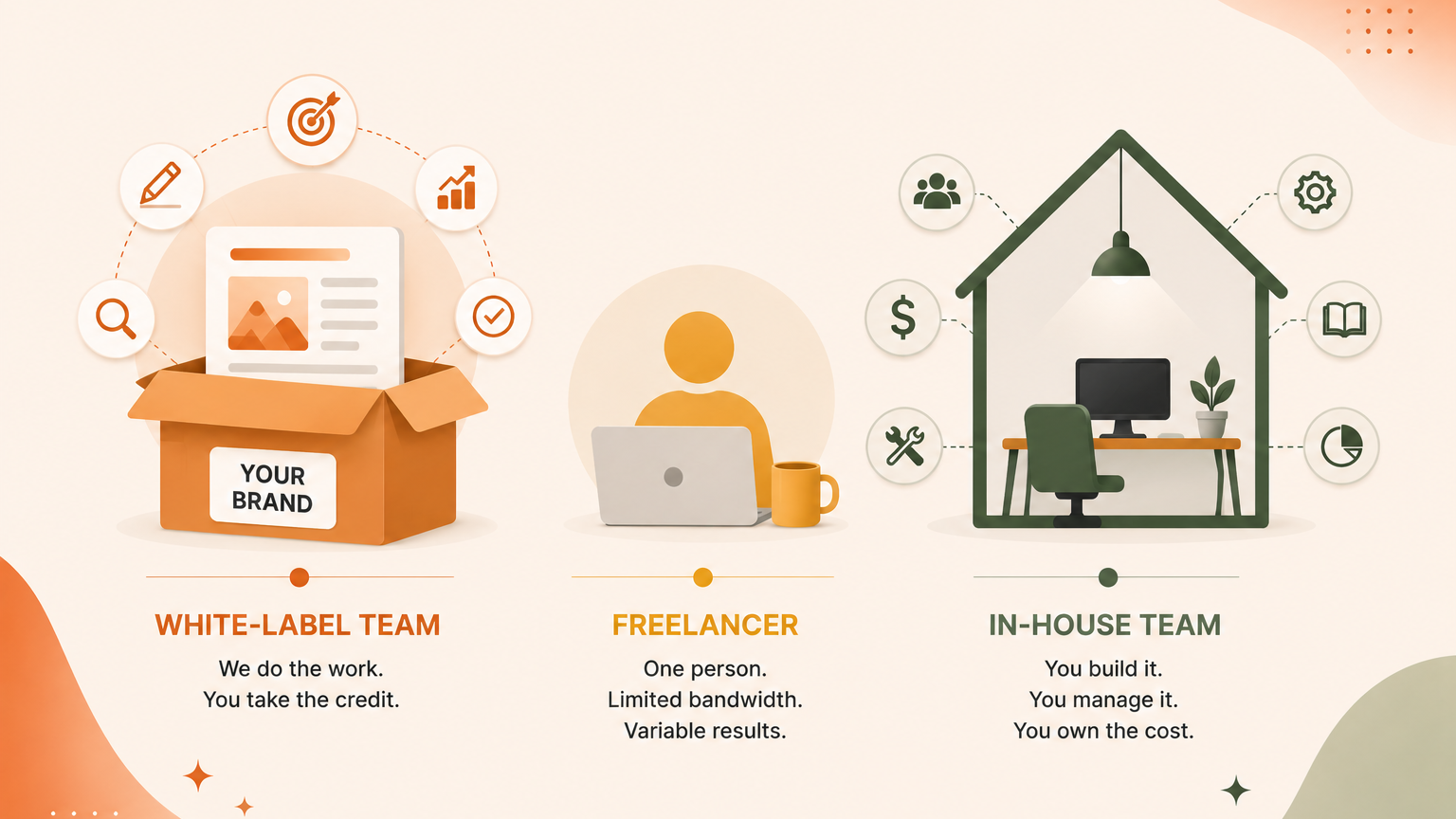
A white-label content team is a third-party provider that produces content to your specifications and delivers it unbranded, so your agency can rebrand and resell it as your own work. You send the brief, keywords, and tone. The provider handles research, writing, editing, and SEO optimization. You review, add your polish, and hand it to the client under your name. Your client never sees the provider. This is the model behind our own white-label content writing services, and it exists precisely so agencies can offer full content execution without carrying a payroll.
What Is an In-House Content Team?
An in-house content team is a set of employees, usually a content manager or strategist, one or more writers, and an editor, who work for your agency full time. You own the hiring, the training, the tools, the quality control, and the salaries. The upside is control and institutional knowledge. The downside is that every one of those costs is fixed and shows up every month, whether you signed three new clients or lost two.
The Third Option: Freelancers, and Why They Rarely Scale
Freelancers sit between the two models. They are variable cost, which is good, but they are not managed for you. You still own the briefing, the quality checks, the chasing of missed deadlines, and the coverage gaps when your best writer goes on holiday. Freelancers work well for low volume. They tend to break down the moment you need consistent output across many clients, which is the exact point where a managed content marketing partner earns its keep.
The True Cost of an In-House Content Team

Most agency owners underestimate in-house cost because they anchor on salary. Salary is the visible number. The real number is the fully-loaded cost, which includes payroll taxes, benefits, software, recruiting, onboarding, management time, and equipment. As a rule of thumb, the fully-loaded cost of an employee runs about 1.25 to 1.4 times their base salary. That multiplier is where in-house budgets quietly break.
Salaries Are Only the Beginning
Using 2026 US market benchmarks, a content writer averages roughly $58,000 to $84,000 in base pay, and a content strategist averages roughly $78,000 to $109,000 depending on the source and seniority. Editors land near the writer band. Below is our fully-loaded cost model for a small in-house team sized to produce meaningful volume. We publish these numbers openly so you can pressure-test them against your own market.
| Cost Component (Annual) | Amount (USD) | Notes |
|---|---|---|
| Content Strategist / Manager (base) | $90,000 | Plans, briefs, QA, reporting |
| Content Writers x3 (base) | $186,000 | $62,000 each, mid-level |
| Editor / QA (base) | $60,000 | Fact-check, polish, consistency |
| Base salary subtotal | $336,000 | Visible cost only |
| Payroll taxes + benefits (~30%) | $100,800 | Health, retirement, PTO, tax |
| Content + SEO tools | $12,000 | Ahrefs, Surfer, Grammarly, AI, CMS |
| Recruiting, onboarding, training | $15,000 | Amortized annually |
| Management overhead + equipment | $20,000 | Software, devices, admin time |
| Total fully-loaded annual cost | $483,800 | About $40,300 per month |
ContentManics 2026 in-house cost model. Team capacity is roughly 36 to 48 long-form articles per month at full utilization. Figures vary by region, seniority, and volume.
The Hidden Costs Nobody Budgets For
Two costs never make it onto the spreadsheet, and both hurt. The first is utilization risk. Your team is paid for a full month even when client work dips, so your effective cost per article rises sharply in slow months. If your $483,800 team ships 36 articles in a busy month, each one costs about $1,120. If demand softens to 18 articles, each one costs about $2,240, and your margin evaporates. The second hidden cost is ramp and turnover. A new writer takes months to reach full quality, and if they leave, you pay to recruit and ramp all over again. White-label absorbs both risks for you.
The True Cost of a White-Label Content Team
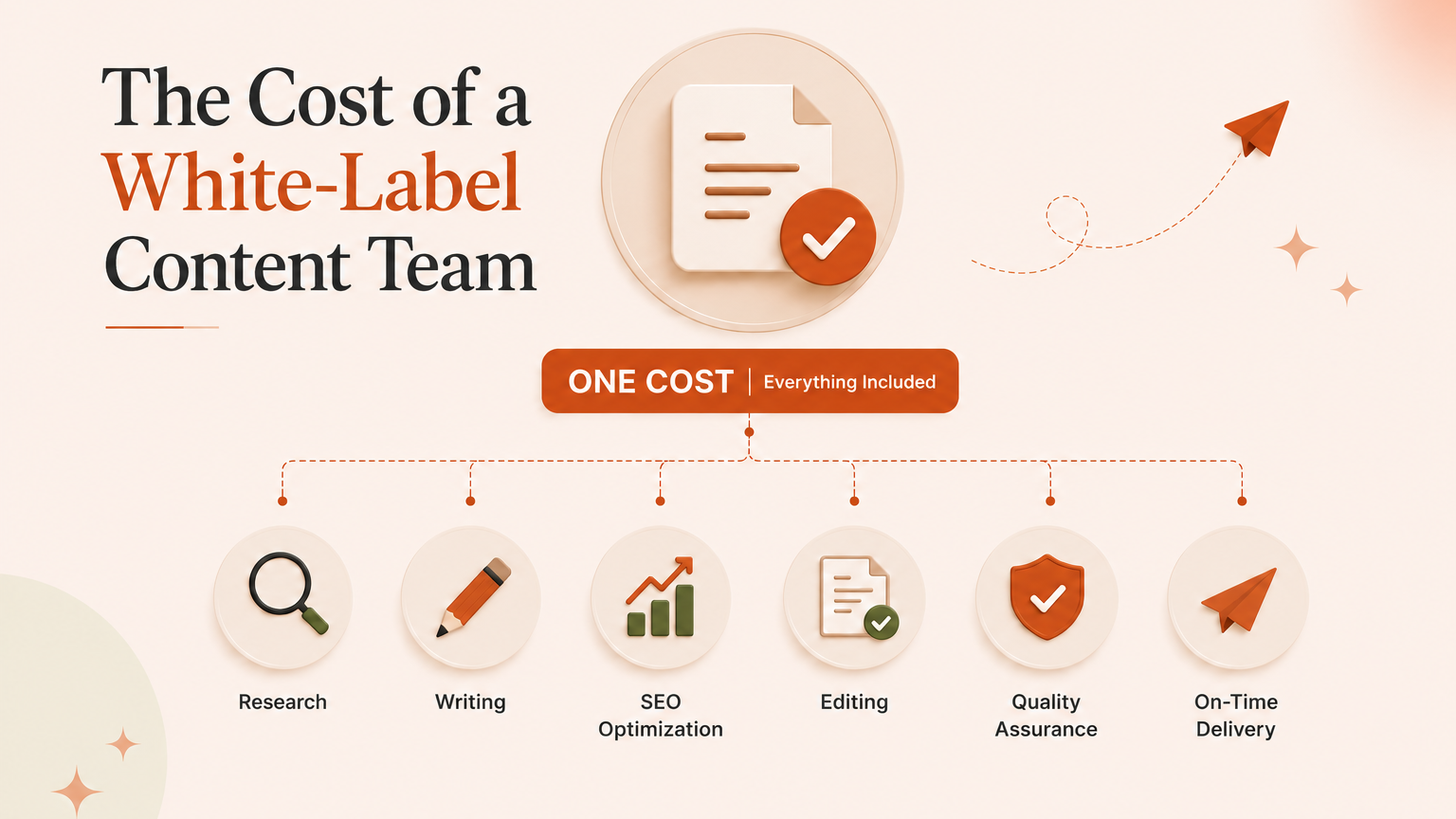
White-label pricing is refreshingly simple: you pay a wholesale rate per deliverable, and that is the whole cost. There is no payroll, no benefits, no tool stack, no recruiting, and no idle-time risk. For a premium, fully-managed, 1,500-word SEO article that includes research, optimization, editing, and revisions, a quality provider like us charges in the range of roughly $200 to $300 wholesale. Content mills go lower, but you get what you pay for, and reworking thin content on your own dime destroys the savings.
What You Are Actually Paying For
A managed white-label rate bundles the entire production chain into one number:
- Keyword and topic research aligned to search intent
- Writing by vetted specialists, often with niche expertise
- Editing, fact-checking, and quality assurance
- On-page SEO optimization and internal-link suggestions
- Revisions until the piece meets your standard
Because the provider spreads its own fixed costs across many agency clients, you get all of this at a fraction of the cost of building it yourself. That is the structural reason white-label is cheaper, and it is why we built our white-label content marketing program around wholesale, per-deliverable pricing rather than retainers you cannot flex.
Where White-Label Saves You Money
The savings are not only in the per-article rate. They are in everything you no longer pay for: no benefits load, no recruiting fees, no software licenses, no management salary spent supervising writers, and, most importantly, no cost when a client pauses. You scale spend up and down in lockstep with revenue. That is the cleanest form of margin protection an agency can buy.
White-Label vs In-House Content: The Cost Comparison Table
Here is the side-by-side that most agency owners are really searching for. This is the comparison to screenshot and bring to your next partner meeting.
| Cost Factor | In-House Team | White-Label Partner |
|---|---|---|
| Cost structure | Fixed (owed monthly) | Variable (per deliverable) |
| Cost per SEO article | ~$850 to $1,120+ | ~$200 to $300 |
| Salaries + benefits | Yes, ~30% load on top | None |
| Tools + software | You buy the full stack | Included in the rate |
| Recruiting + onboarding | Yours to fund | None |
| Idle-time / utilization risk | High | Zero |
| Time to launch | 2 to 4 months to hire | Days |
| Scalability | Slow, hire-led | Instant, on demand |
| Control over process | Full | Shared, via briefs |
| Best for | Steady high volume, one niche | Variable demand, many niches |
ContentManics 2026 cost comparison. Per-article figures assume a 1,500-word, SEO-optimized long-form article.
The Margin Math: How Each Model Affects Your Profit
Cost is only half the story. What you actually take home is margin, and this is where the two models separate for good. We will use a single, realistic unit: one fully-managed 1,500-word SEO article that your agency sells to a client at a $1,000 retail price. We chose $1,000 because it reflects a common mid-market managed rate. Adjust it to your own pricing and the ratio holds.
Per-Article Margin, Side by Side
| Metric (per article) | In-House | White-Label |
|---|---|---|
| Retail price to client | $1,000 | $1,000 |
| Your cost to produce | ~$850 | ~$250 |
| Gross profit | ~$150 | ~$750 |
| Gross margin | ~15% | ~75% |
Illustrative margin model. In-house cost assumes strong writer utilization; at partial utilization, in-house margin trends toward zero or negative.
The Monthly View That Changes Minds
The per-article gap is stark, but the monthly view is what makes agency owners rethink their whole operation. Imagine you sell 30 articles this month at $1,000 each, for $30,000 in revenue.
- White-label: Your cost is 30 x $250, which is $7,500. Gross profit is $22,500, a clean 75% margin. If next month you sell only 10 articles, your cost drops to $2,500. Spend follows revenue.
- In-house: Your team costs about $40,300 every month regardless of sales. Sell 30 and you are underwater versus the fixed cost. Sell 10 and the damage is worse. You are carrying a payroll that does not shrink when the pipeline does.
This is the pain point we hear most often from agency owners: revenue is lumpy, but the in-house payroll is not. White-label removes that mismatch. Your cost of delivery breathes in and out with your client demand, which is exactly how a healthy, resilient agency should be built.
When Does Each Model Make Sense?
We are not here to tell you in-house is always wrong. It is not. The right answer depends on your volume, your niche depth, and your appetite for fixed cost. Here is how we advise clients to choose.
Choose In-House When
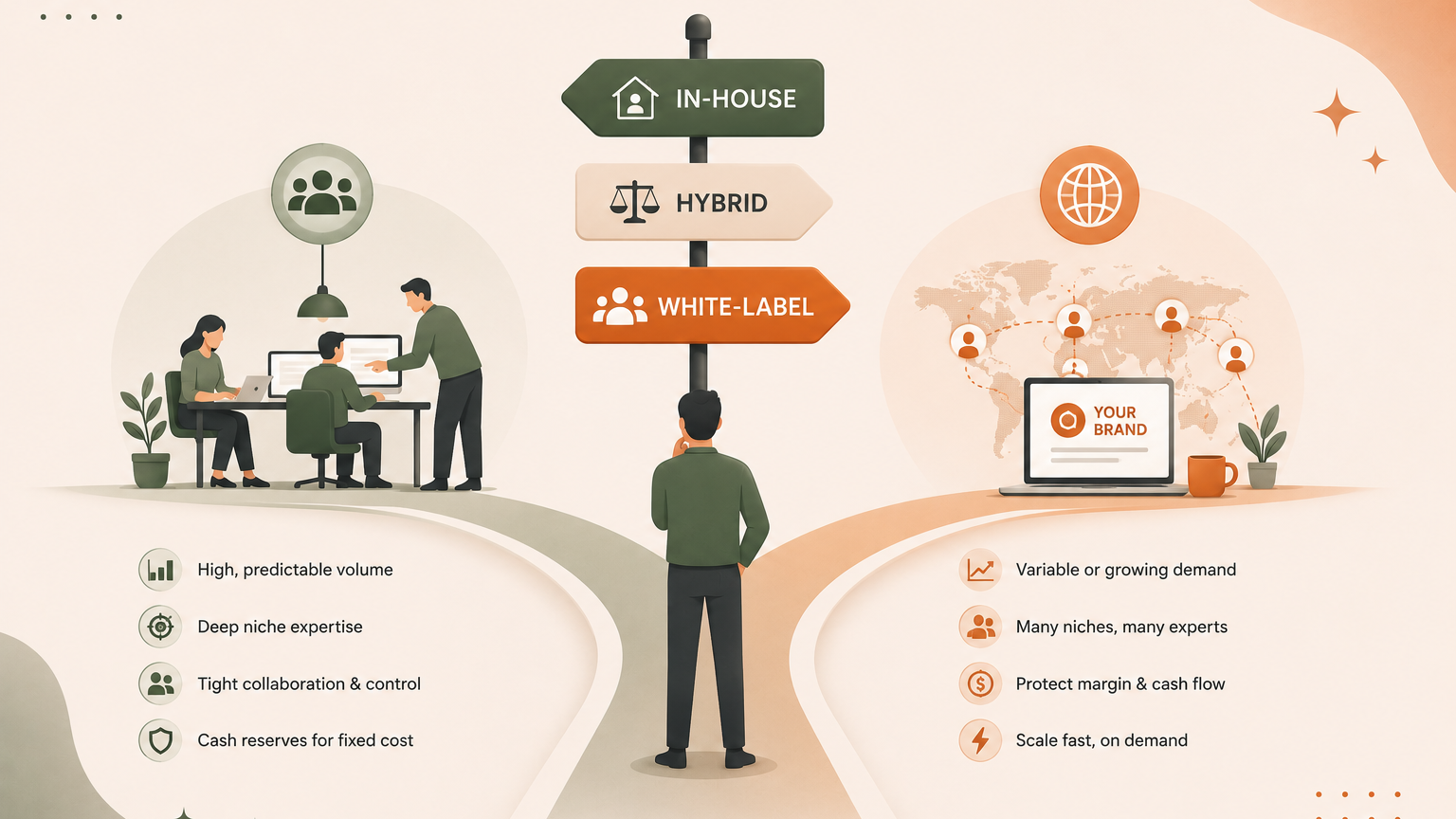
- You have consistent, predictable, high-volume demand that keeps writers fully utilized every month.
- You operate in one deep niche where proprietary, hard-won expertise is a competitive moat.
- You need same-room collaboration, tight brand immersion, and total process control.
- You have the cash reserves to carry payroll through slow quarters without stress.
Choose White-Label When
- Your client demand is variable, seasonal, or still growing, and you cannot guarantee full writer utilization.
- You serve many niches and need specialist writers across all of them without hiring for each.
- You want to protect margin and cash flow by keeping delivery cost variable.
- You need to scale output this week, not after a two-month hiring cycle.
The Hybrid Model: The Best of Both
In practice, the smartest agencies we work with do not choose one model at all. They keep strategy, client relationships, and final editorial sign-off in-house, where control matters most, and they white-label the production, where variable cost matters most. This hybrid keeps your brand voice and client trust close to the chest while your margin stays protected and your capacity stays elastic. It is the model we designed our services to support, and it is how a lean agency competes with shops three times its size.
How ContentManics Helps Agencies Protect Their Margins

We built ContentManics for exactly the agency owner reading this: someone who wants to offer world-class content without betting the business on a fixed payroll. Our white-label content marketing program gives you a fully managed production team, on demand, under your brand, at wholesale per-deliverable pricing. You brief us, we research, write, edit, and optimize, and you deliver to your client as your own.
What that means for your margins and your peace of mind:
- Variable cost only, so your delivery expense flexes with client demand and never sits idle.
- Specialist writers across niches, so you can say yes to more clients without hiring for each vertical.
- Built-in SEO, editing, and QA, so what you hand your client is ready to publish, not ready to rewrite.
- Fast, elastic scale, so a new client win becomes a same-week delivery instead of a hiring project.
If you want to see how the math works for your specific pricing and volume, talk to our team and we will build the cost and margin model with your real numbers. You can also read our guide on how to price white-label content for your agency to make sure your retail rates capture the full margin the model makes possible.
Frequently Asked Questions
-
Is white-label content cheaper than in-house?
Yes, in most cases. White-label content is a variable cost of roughly $200 to $300 per premium SEO article, while a fully-loaded in-house team costs about $850 or more per article once salaries, benefits, tools, and management are included. In-house only becomes cost-competitive at very high, steady volume with full writer utilization.
-
What profit margin can agencies make reselling white-label content?
Agencies reselling premium white-label content typically earn a 55% to 75% gross margin. At a $1,000 retail price with a $250 wholesale cost, the gross profit is about $750 per article, or roughly 75%. Because the cost is variable, that margin holds even when client demand fluctuates.
-
What are the hidden costs of an in-house content team?
The hidden costs are the payroll load of about 30% for taxes and benefits, software and tool licenses, recruiting and onboarding, management time, and utilization risk. Utilization risk is the biggest one: you pay full salaries even in slow months, which pushes your effective cost per article far above the salary figure.
-
Is white-label content lower quality than in-house?
Not when you choose a managed, premium provider. Quality depends on the partner, not the model. A strong white-label team uses vetted specialist writers, editors, and SEO optimization, and revises until the piece meets your standard. Cheap content mills are the real quality risk, which is why the per-deliverable rate matters.
-
Can I use white-label and in-house together?
Yes, and many high-performing agencies do. The common hybrid keeps strategy, client relationships, and final editorial control in-house, and white-labels the production to keep delivery cost variable. This protects both quality and margin while keeping your capacity elastic.
The Verdict
| White-label content wins on cost and margin for the vast majority of agencies. It turns a roughly $40,000-per-month fixed payroll into a variable cost that flexes with demand, lifting gross margin from about 15% in-house to about 75% white-label at the same retail price. Build in-house only when you have steady, high-volume demand in a single niche and want total control. For everyone else, white-label, or a hybrid of in-house strategy plus white-label production, is the model that protects your profit. |
If your agency sells content and your margin feels thinner than it should, the model is usually the reason, not the effort. We would be glad to help you fix it. Explore our white-label content services or get in touch to run your own cost and margin breakdown with our team.


Leave a Reply