
If you run an agency, a SaaS brand, or a lean marketing team, you already know the squeeze. Demand for content keeps climbing, deadlines keep tightening, and your in-house bandwidth stays exactly where it was last quarter. We have sat on both sides of that problem, and we will be honest with you: hiring your way out of it is slow and expensive. This is the gap that white-label content delivery was built to close, and in this guide we walk through the full process, step by step, so you can see how it works, judge the quality for yourself, and decide whether it fits your growth plans.
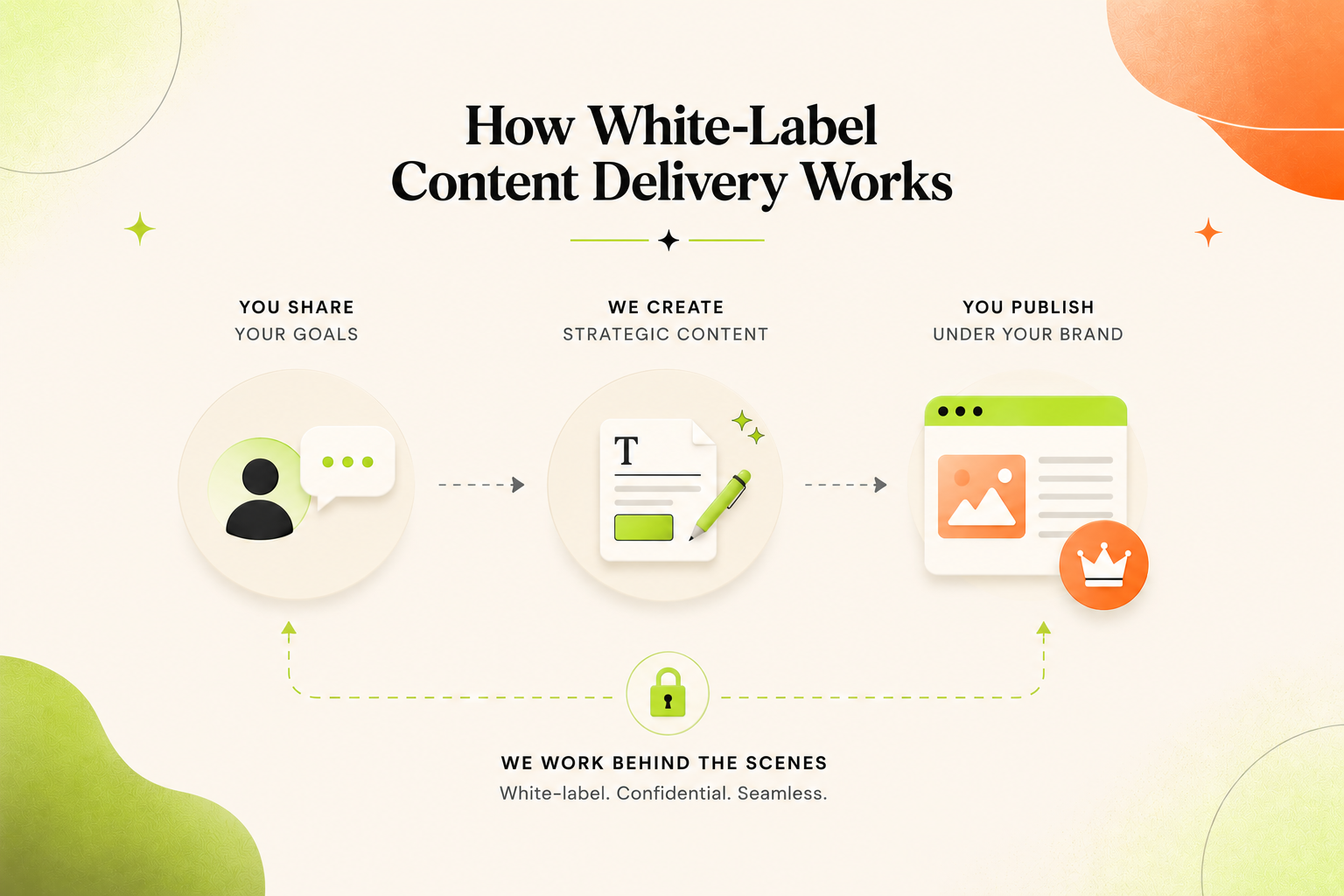
Quick answer: White-label content delivery is the process in which a specialized provider researches, writes, edits, optimizes, and delivers unbranded content that your business publishes under its own name. The provider stays invisible, you keep the client relationship, and the content arrives ready to use, in your brand voice, on schedule.
We approach this the way a semantic SEO practitioner would, using the topical authority principles taught in the Koray framework. That means we answer the core question first, then cover the connected attributes (the production process, the roles, the quality gates, the benefits, and the trade-offs) in a logical order that both readers and search engines can follow. If you want the short version, jump to the seven-step process below. If you want the full picture, stay with us.
Key Takeaways
- White-label content delivery lets you sell or publish content produced by a third party as if it were made in-house.
- The process follows seven repeatable stages, from onboarding and strategy through production, quality assurance, delivery, and reporting.
- A strong production process is what separates a reliable partner from a content mill: briefs, editorial review, and brand-voice checks matter more than raw output.
- Modern white-label content is optimized for SEO, AEO (answer engines), and GEO (generative engines) at the same time.
- The right partner scales with you, protects your confidentiality, and delivers in a format you can publish immediately.
What Is White-Label Content Delivery?
White-label content delivery is a business arrangement and a workflow. A client (usually an agency, a publisher, or an in-house team) briefs a white-label content provider on what it needs. The provider produces the content behind the scenes, strips out any of its own branding, and hands back a finished asset the client can rebrand and publish as its own. The end customer never sees the provider. That invisibility is the whole point, and it is why the model is sometimes called private-label or ghost-produced content.
We like to explain it with a non-content example. A handful of factories produce a large share of the skincare products on the shelf. The same serum comes off the same line, then gets different labels and different marketing depending on which brand bought it. White-label content works the same way. You are simply swapping the serum for a researched, edited, publish-ready article, landing page, or email sequence.
White-Label vs Outsourced vs Freelance Content
People use these terms loosely, so let us draw the line clearly. The difference sits in three places: who keeps the credit, how the work is managed, and how consistent the output is.
| Aspect | White-Label Delivery | Freelance / Ad-hoc Outsourcing |
| Credit & branding | Fully unbranded; you publish as your own | Varies; bylines and attribution can be messy |
| Process | Managed workflow with briefs, editing, and QA | You manage each writer and each revision |
| Consistency | Standardized voice and quality at scale | Depends on the individual writer’s day |
| Scaling | Add volume without hiring or training | Re-recruit and re-onboard for every gap |
In short, freelancing gives you a writer. White-label delivery gives you a production system. For the cost side, see white-label vs in-house content team.
Who Uses White-Label Content Delivery?
The model fits any team that sells or publishes more content than it can comfortably produce. In our experience, five groups lean on it most:
- Digital and SEO agencies that want to offer content as a service without building an editorial department.
- SaaS and tech companies that need a steady stream of educational blog posts, docs, and comparison pages.
- E-commerce brands that require product descriptions, buying guides, and category copy at volume.
- Publishers and media teams filling content gaps or spinning up new verticals quickly.
- In-house marketing teams covering overflow during launches, seasons, or hiring freezes.
How Does White-Label Content Delivery Work? The 7-Step Process
Here is the part everyone wants. Below is the exact production process we run, described as a repeatable sequence. Each step feeds the next, which is what keeps quality steady even as volume grows. Read the quick list first, then we break down every stage.
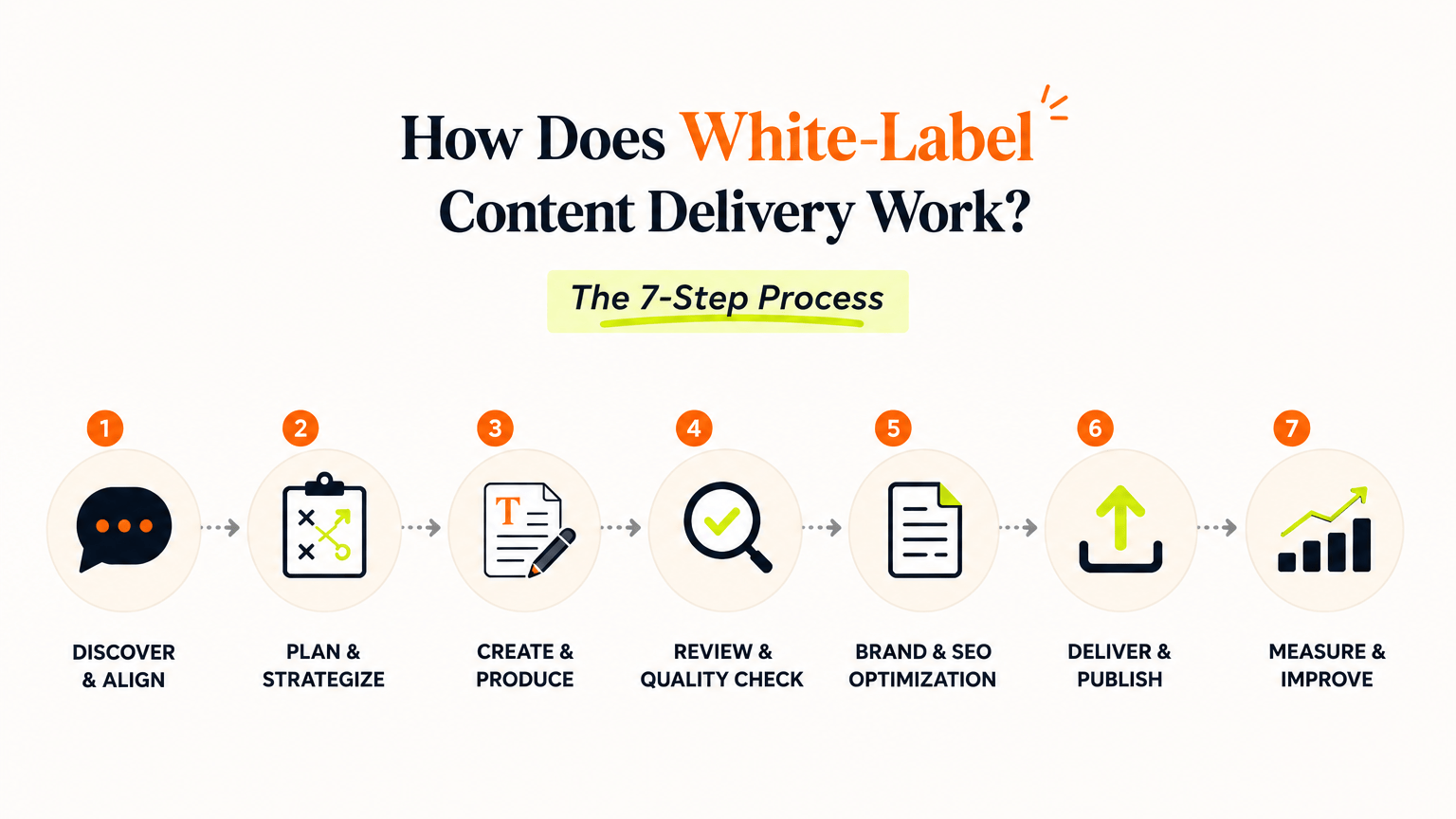
- Onboarding and brand discovery so the content sounds like you.
- Strategy and topical mapping to decide what to create and why.
- Content brief creation that defines intent, structure, and keywords.
- Content production where writers turn briefs into drafts.
- Editing, QA, and optimization for accuracy, voice, and search readiness.
- White-label delivery and handoff in a publish-ready, unbranded format.
- Reporting, feedback, and iteration to improve every cycle.
Step 1: Onboarding and Brand Discovery
Everything starts with understanding your brand. We collect your style guide, tone of voice, target audience, product details, competitors, and any past content that performed well. If you do not have a documented voice yet, we build one with you. This is the step most content mills skip, and it is exactly why their output reads generic. Getting brand discovery right up front means the content comes back sounding like you, not like a stranger guessing at your industry.
Step 2: Strategy and Topical Mapping
Next, we decide what to create and in what order. This is where the semantic SEO discipline earns its keep. Instead of chasing one keyword at a time, we build a topical map: the central topic, its subtopics, and the supporting questions your audience actually asks. Covering a topic completely is how you earn topical authority, and it is why a planned content network outperforms a pile of disconnected posts. If you already have a strategy, we align to it. If you do not, our content strategy service can map it for you.
Step 3: Content Brief Creation
A brief is the blueprint, and a good one prevents ninety percent of revisions. Each brief we prepare names the search intent, the target query and its related entities, the recommended structure (H1, H2, H3), word count, internal and external links, and the answer that should appear near the top for answer engines. The clearer the brief, the closer the first draft lands. We treat the brief as a contract between strategy and production, so nothing gets lost in translation.
Step 4: Content Production
Now the writing happens. A subject-matter writer, matched to your niche, turns the brief into a draft. Strong providers keep a vetted bench of writers across industries such as SaaS, finance, healthcare, and e-commerce, so your content is produced by someone who understands the field, not just the grammar. Our content creation service pairs each project with a writer who fits the topic, which is what keeps the depth and accuracy high. This is the production-process attribute that quietly determines whether readers trust the piece.
Step 5: Editing, QA, and Optimization
Every draft passes through editing and quality assurance before it goes anywhere near delivery. Editors check facts, tighten the writing, confirm the piece matches the brand voice, and run it against the brief. This is also where we handle SEO optimization: clean heading hierarchy, keyword placement that reads naturally, internal linking, meta title and description, schema recommendations, and readability. We optimize for humans first and machines second, because content that only pleases a crawler tends to please no one.
Step 6: White-Label Delivery and Handoff
The finished asset is delivered fully unbranded and publish-ready, usually in Google Docs, a Word file, or straight into your CMS. There are no logos, no bylines, and no fingerprints from the provider. You add your brand, assign the author name you want, and publish. Because the piece already includes titles, subheadings, internal links, and meta fields, the handoff is genuinely plug-and-play. Your client, or your audience, only ever sees your name on it.
Step 7: Reporting, Feedback, and Iteration
The process does not end at delivery. We track how content performs, gather your feedback, and fold both back into the next cycle. Rankings, traffic, and engagement tell us what to double down on and what to refine. Over time this feedback loop sharpens the brand voice, tightens the briefs, and lifts the results, which is how a white-label relationship compounds instead of plateauing.
In one line: Discover your brand, map the topics, brief the piece, write it, edit and optimize it, deliver it unbranded, then measure and improve. Repeat.
The Production Process Behind White-Label Content
The seven steps describe the journey of a single piece. Zoom out, and there is a production engine making that journey repeatable at scale. This is the part clients rarely see, and it is the part that actually determines reliability.
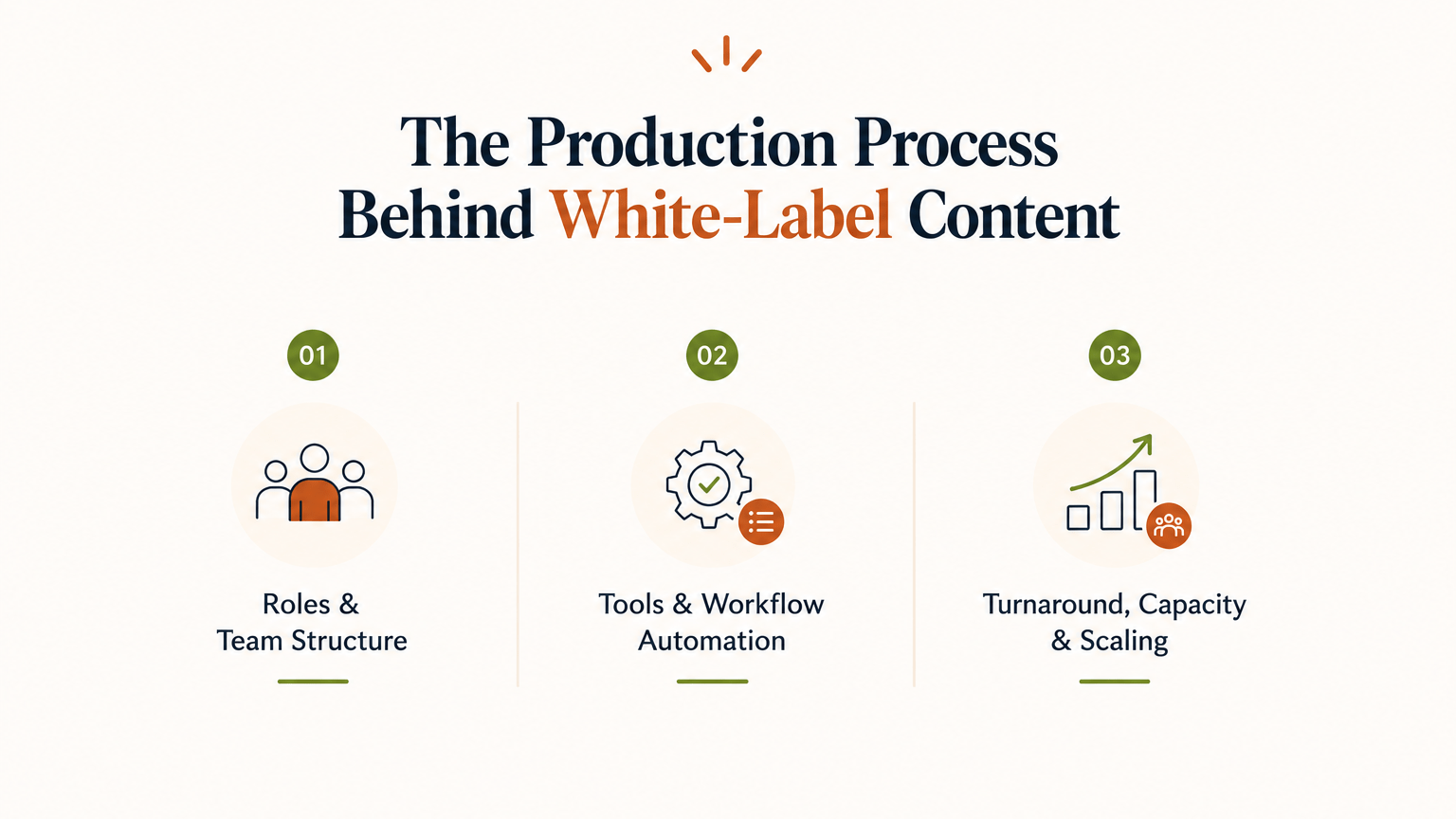
Roles and Team Structure
A dependable white-label operation is a team, not a lone writer. In a typical setup you will find:
- An account or project manager who owns communication and deadlines.
- A content strategist who builds the topical map and briefs.
- Subject-matter writers matched to your industry.
- Editors and QA specialists who protect quality and voice.
- An SEO and optimization lead who aligns each asset with search and answer engines.
Tools and Workflow Automation
Behind the roles sits a workflow. Project boards track each piece from brief to delivery, shared dashboards keep orders organized, and version control keeps revisions clean. The best providers automate the boring parts (status updates, formatting, checklists) so human attention goes where it matters: research, judgment, and voice. Automation is a support act here, never the star.
Turnaround, Capacity, and Scaling
Because the process is standardized, capacity becomes a dial you can turn. Need two posts this month and twelve next month? A mature white-label partner absorbs that swing without you hiring, training, or renegotiating. This flexibility is the quiet superpower of the model, and it is why agencies use it to take on work they would otherwise have to decline. You can review our full content services to see how capacity maps to different needs.
What Makes White-Label Content Delivery Actually Work
Plenty of providers can produce words. Far fewer can deliver content you would proudly put your name on. Three factors separate the two.
Brand Voice Consistency
Consistency is the difference between content that feels in-house and content that feels bolted on. This is why brand discovery in Step 1 matters so much, and why voice checks belong in every QA pass. When the voice is right, no one can tell the content was produced externally, which is exactly the outcome you are paying for.
SEO, AEO, and GEO Alignment
Search has changed, and modern white-label content has to keep up. We optimize on three fronts at once. For classic SEO, we structure content around intent, entities, and clean on-page signals. For AEO (answer engine optimization), we lead with direct, quotable answers and clear question-and-answer sections so tools like AI Overviews and voice assistants can lift them. For GEO (generative engine optimization), we write content that large language models can cite: well-structured, factual, and rich in named entities. Our AEO and GEO optimization service is built specifically for this shift, because ranking on Google is no longer the only game.
Confidentiality and the White-Label Guarantee
The model only works if the provider stays invisible. A serious partner guarantees that your clients never learn a third party was involved, keeps all deliverables unbranded, and treats your relationships as yours alone. Confidentiality is not a nice-to-have here. It is the foundation the entire arrangement rests on.
Benefits of White-Label Content Delivery
When the process above runs well, the payoff shows up in four places:
- Scale without headcount. Add output without the cost and delay of hiring an editorial team.
- Expanded service range. Offer blogs, web copy, email, and more, even in niches outside your core.
- Faster time to market. Pre-built workflows mean content ships on a predictable schedule.
- Higher margins and retention. More value for clients, less overhead for you, and stickier relationships.
Common Challenges (and How We Solve Them)
We would be doing you a disservice if we pretended the model has no downsides. It does, and every one of them is manageable when you know what to look for.
- Loss of control over voice. The fix is thorough onboarding and a documented style guide, so writers are never guessing.
- Inconsistent quality. The fix is a real editorial process with briefs and QA, not a marketplace of anonymous freelancers.
- Communication gaps. The fix is a dedicated point of contact and clear feedback loops after every delivery.
- Generic, AI-flattened writing. The fix is subject-matter writers and human editing that adds genuine insight, not just clean grammar.
We built our process specifically to remove these friction points, because we have felt each of them ourselves. If any of this sounds familiar, that recognition is usually the sign that a managed white-label partner is the right next move.
How to Choose a White-Label Content Delivery Partner
If you are weighing options, here is the checklist we would use ourselves. Ask any provider to prove the following before you commit:
- Can they show samples and case studies in your niche?
- Do they run a documented process with briefs, editing, and QA, or just assign writers?
- Do they optimize for SEO, AEO, and GEO, not just keywords?
- Do they guarantee unbranded, confidential delivery?
- Can they scale volume up and down without drama?
- Do you get a real point of contact, or a ticket queue?
At ContentManics, this checklist is not a sales pitch, it is how we operate. We handle everything from ideation to publishing, optimize for search and AI visibility, and deliver clean, unbranded, ready-to-publish content that carries your name, not ours. If you would like to see how the process would run for your brand, get in touch with our team and we will map it out with you.
Want to compare providers side by side? See the best white-label AI-first content marketing partners for agencies.
Frequently Asked Questions
What is white-label content delivery in simple terms?
It is when a specialized provider creates content behind the scenes and delivers it unbranded, so your business can publish it under its own name. The provider stays invisible and you keep full credit.
How long does white-label content delivery take?
Turnaround depends on length and complexity, but a standardized production process makes timelines predictable. Many providers deliver individual pieces within a few business days and ongoing volume on a fixed monthly schedule.
Is white-label content bad for SEO?
No, as long as it is original, well-researched, and optimized. Problems only arise with duplicated or low-effort content. Quality white-label content is written from scratch, brand-matched, and optimized for SEO, AEO, and GEO.
Will my clients know I used a white-label provider?
Not with a reputable partner. Deliverables arrive fully unbranded, and confidentiality is a core part of the arrangement. Your clients only ever see your brand on the finished work.
Who should use white-label content services?
Agencies, SaaS and tech companies, e-commerce brands, publishers, and in-house teams that need more high-quality content than they can produce internally. You can explore options on our services page.
Bringing It All Together
White-label content delivery is not a shortcut, it is a system. When the seven steps run in order, brand discovery, strategy, briefing, production, quality assurance, delivery, and iteration, you get content that reads like your own team wrote it, ships on schedule, and performs across search and AI channels. That is the whole promise: your name, your voice, your growth, without the overhead of building a production department from scratch.
We have walked hundreds of pieces through this exact process, and the pattern holds every time: the strength of the workflow, not the size of the team, is what decides the result. If you are ready to see that workflow applied to your brand, explore the ContentManics blog for more guides, or start a conversation with us. We would be glad to show you how it works, on your content, with your name on it.



Leave a Reply