
A white-label content marketing agency is a specialized partner that creates content, blogs, SEO articles, and web copy that another agency resells to its clients under its own brand. The client never sees the third party. Your agency keeps the relationship, the credit, and the invoice, while an expert team quietly does the writing behind the scenes.
If you run an agency, you already know the squeeze. Demand for content keeps climbing, deadlines keep tightening, and hiring a full in-house team feels risky when client budgets shift month to month.
We have sat on your side of that table, and this guide is written to answer the exact question a lot of agency owners type into Google at 11 p.m.: what is a white label content marketing agency, and is one right for us? Below, we break down what these partners actually do, how the model works, what it costs, and how to choose the best white label content partner without getting burned.
What Is a White-Label Content Marketing Agency?
A white-label content marketing agency is a business-to-business content provider. It produces marketing content for other agencies, who then deliver that content to end clients as their own. The term “white label” comes from manufacturing, where a product is made by one company, stripped of its branding, and sold under another company’s label. In content, the product is words: blog posts, landing pages, email sequences, case studies, and full SEO content campaigns.
The defining attribute of the white-label model is invisibility. A good white label partner is anonymous by design. Your clients believe the work came from your team, because as far as the deliverable is concerned, it did. You set the brief, you own the client relationship, and you present the finished content under your logo. That single attribute, brand anonymity, is what separates a white-label agency from a standard content vendor or a freelancer who signs their own work.
White-Label vs. Private Label vs. Reseller: Clearing Up the Terms

These three phrases get used interchangeably, but they carry different meanings, and knowing the difference helps you buy smarter.
- White label: Fully unbranded content that you rebrand as your own. The producer stays hidden. This is the model most agencies want.
- Private label: Similar in practice, though the phrase is more common in physical products. In content, people often use it as a synonym for white label.
- Content reseller: A partner that lets you resell content services, sometimes with a partner portal and its own light branding. Reselling and white labeling overlap, but a true white-label arrangement removes every trace of the third party.
The Central Idea: You Sell the Strategy, We Handle the Production
The healthiest white-label relationships draw a clean line. Your agency owns strategy, positioning, and the client relationship. The white-label partner owns execution and production capacity. You know your client’s voice, goals, and audience better than anyone. We turn that knowledge into publish-ready content at a volume your in-house team could not sustain alone. When that division of labor is respected, the arrangement scales beautifully.
How Does a White-Label Content Marketing Agency Work?
The mechanics are simpler than most people expect. A white-label content engagement follows a repeatable loop that runs the same way whether you order one blog post or forty pieces a month.
The White-Label Content Workflow, Step by Step
- You submit a brief. You share the topic, target keyword, tone, word count, audience, and any brand guidelines. The more context you give, the closer the first draft lands.
- We research and write. A vetted writer, often a subject-matter specialist, produces the content, optimized for search intent and structured for readability.
- We edit and quality-check. An editor reviews the draft for accuracy, SEO, and voice before it ever reaches you.
- You review and refine. The draft comes back to you for feedback. You request revisions until it matches your standard.
- You deliver it as your own. Once approved, you hand the fully branded content to your client. Your name is on it, start to finish.
Who Owns the Content and the Client Relationship?
You do. In a legitimate white-label agreement, full rights transfer to you on payment, and the partner is bound by confidentiality. Your client is never contacted, never invoiced, and never told a third party exists. This matters, because the entire value of the model rests on trust. We treat your client roster as sacred, and we recommend you insist on a written confidentiality clause with any partner you consider. To be clear, yes, white labeling is completely legal and standard practice across the marketing industry.
| INSIDER NOTE FROM CONTENTMANICS The agencies that win with white label do not “hand off and hope.” They assign one internal point of contact who owns the brief and the feedback loop.That single habit is the biggest predictor of whether an outsourced content program feels seamless or chaotic. We build our onboarding around it. |
What Services Does a White-Label Content Marketing Agency Offer?
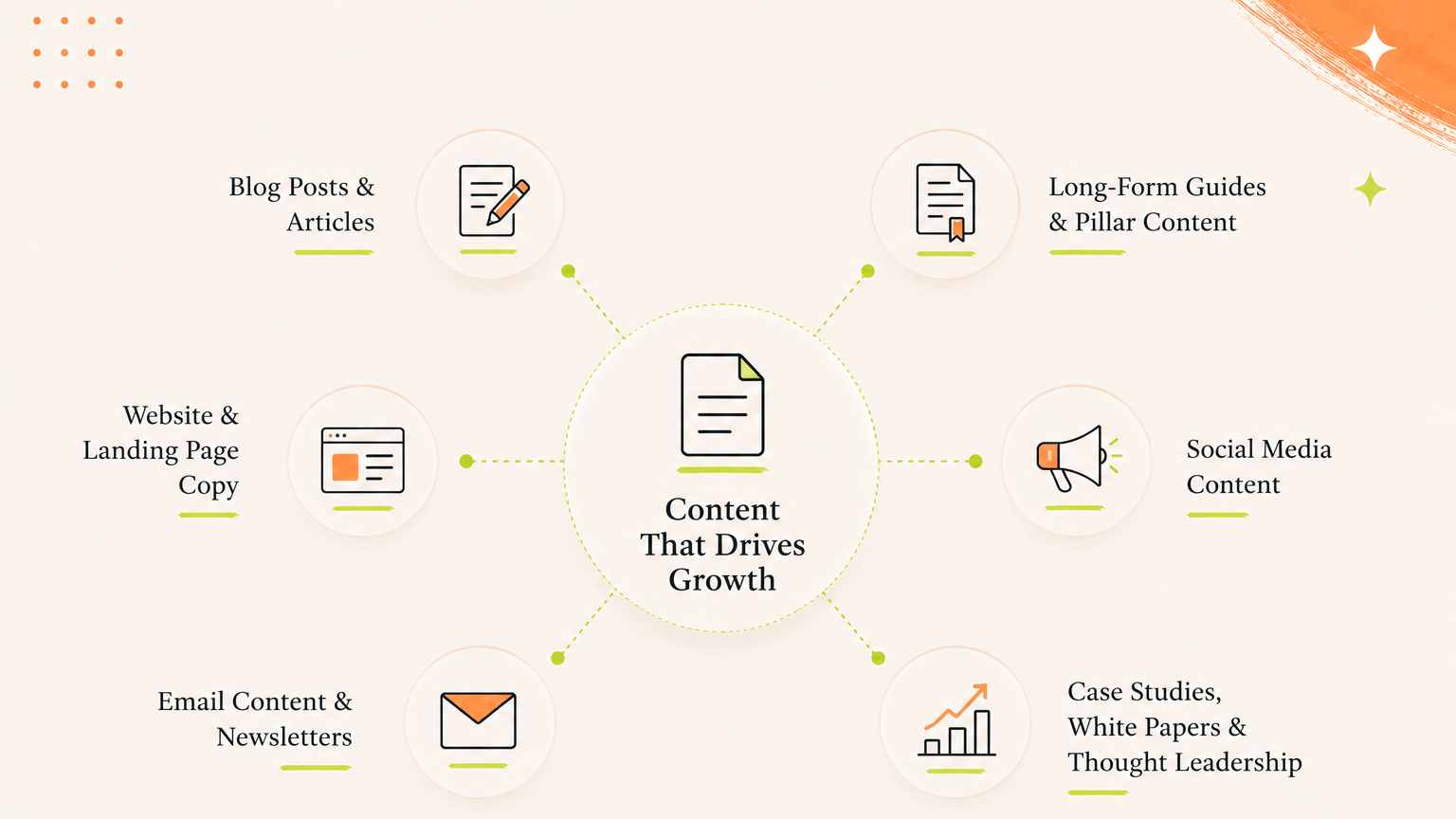
The best white-label partners cover far more than blog posts. Because your clients span industries and funnel stages, a strong partner offers a full menu you can resell. Here is what a modern white label content marketing agency typically produces.
Core Content Deliverables
- Blog posts and articles that build organic traffic and topical authority for your clients.
- Website and landing page copy written to convert, not just to fill space.
- Long-form pillar pages and guides like the one you are reading now, engineered to own a topic.
- Email sequences and newsletters for nurture, onboarding, and retention.
- Social media content to keep client channels consistent and active.
- Case studies, white papers, and thought leadership that position your clients as experts in their field.
SEO, AEO, and GEO Content Services
Content is only useful if people, and machines, can find it. That is why our production is built around three layers of discoverability. Traditional search engine optimization earns rankings on Google. Answer Engine Optimization (AEO) structures content so it wins featured snippets and “People Also Ask” boxes. Generative Engine Optimization (GEO) shapes content so it gets cited inside AI answers from tools like ChatGPT, Gemini, and Perplexity. A partner that ignores AEO and GEO is optimizing for a version of search that is quietly shrinking.
- Keyword and topical map research that plans a whole cluster, not one-off posts.
- On-page optimization including titles, headers, meta descriptions, and internal linking.
- Answer-first formatting with clear definitions and question-based headings that AI systems can extract.
- Content refreshes that revive older client pages losing rank.
At ContentManics, every deliverable ships with this layered approach baked in, which means the content you resell is ready to compete in both classic search and AI-driven discovery. You can see how we structure a full program on our white-label content marketing page.
Why Do Agencies Use White-Label Content Marketing Partners?
Let us be honest about the pain, because we have felt it too. Agencies rarely fail from a lack of clients. They stall because delivery cannot keep pace with sales. White-label content solves the delivery problem without forcing you to gamble on payroll. Here is what that looks like in practice.
Scale Without Hiring
Hiring, onboarding, and retaining an in-house content team is expensive and slow. A white-label partner lets you scale output up or down in days, not quarters. When a big client signs, you deliver. When a project ends, you are not carrying idle salaries. You buy capacity only when you need it.
Protect Your Margins and Your Cash Flow
Full-time writers, editors, and SEO specialists carry salaries, benefits, software, and management overhead whether or not work is flowing. White-label content converts that fixed cost into a variable one. You pay per project or per package, mark it up, and keep a healthy margin. For most agencies, this is the difference between chasing revenue and actually banking profit.
Access Niche Expertise on Demand
Your clients might operate in fintech one month and healthcare the next. No small in-house team covers every niche credibly. A strong white-label agency taps a bench of specialist writers, so you can accept work in industries your own staff has never touched, and still deliver content that reads like it came from an insider.
Say Yes More Often
Every project you turn down for lack of bandwidth is revenue handed to a competitor. With a reliable content partner behind you, “we are at capacity” stops being a reason to lose deals. You expand your service menu, take on overflow, and grow without the growing pains.
White-Label Agency vs. Freelancers vs. In-House: A Comparison
When agencies weigh how to produce content at scale, three options usually make the shortlist. This comparison table lays out how a white-label content marketing agency stacks up against hiring freelancers and building an in-house team, so you can spot the best white label content partner fit for your situation.
| Factor | White-Label Agency | Freelancers | In-House Team |
|---|---|---|---|
| Speed to scale | Fast, on demand | Slow, one at a time | Very slow, months to hire |
| Cost model | Variable, pay per project | Variable, per project | Fixed, salaries and overhead |
| Quality control | Built-in editing layer | Depends on the individual | High, but resource-heavy |
| Niche coverage | Broad specialist bench | Narrow, one or two niches | Limited to who you hired |
| Management load | Low, one point of contact | High, you manage each writer | High, ongoing team management |
| Brand anonymity | Full, invisible to clients | Varies, may want credit | Not applicable |
| Best for | Agencies scaling delivery | Small, occasional needs | Large, stable content volume |
The honest takeaway: freelancers suit small or occasional needs, an in-house team makes sense once your content volume is large and stable, and a white-label partner is the sweet spot for agencies that need to scale delivery quickly while protecting margins. Many agencies blend all three, keeping a lean in-house core and leaning on a white-label partner for overflow and specialist work.
How to Choose the Best White-Label Content Marketing Partner
Not every provider is built the same, and a wrong-fit partner can quietly damage your reputation with your own clients. Choosing well is a bottom-of-funnel decision, so slow down and vet properly. Here is the checklist we would use if we were in your seat.
Questions to Ask Before You Sign
- Can I see samples and case studies? Real published work in your clients’ industries beats any sales pitch.
- How do you vet writers? Ask about screening, editing, and how they match writers to niches.
- Is confidentiality contractual? Insist on written anonymity so your client relationship stays yours.
- How flexible are revisions? You want a clear revision policy, not a fight over every edit.
- Do you optimize for SEO, AEO, and GEO? Content that cannot be found, or cited by AI, will not move client numbers.
- Can you match our brand voice and style guide? Customization depth is what makes outsourced content feel in-house.
- How is pricing structured? Look for transparent, predictable rates you can mark up cleanly.
Red Flags to Avoid
- Promises of overnight rankings. Real content results compound over months, and anyone guaranteeing instant wins is selling a story.
- No editing layer. If a partner ships first drafts straight from writers, quality will swing wildly.
- Vague pricing. Hidden fees and murky scopes wreck your margins.
- Reluctance to sign confidentiality. If a partner will not stay invisible, walk away.
We built ContentManics to pass every one of these tests: vetted specialist writers, a real editorial layer, ironclad confidentiality, transparent pricing, and content optimized for search and AI answers. When you are ready to compare us against your shortlist, our team is happy to walk you through samples on a quick call.
How Much Does White-Label Content Marketing Cost?
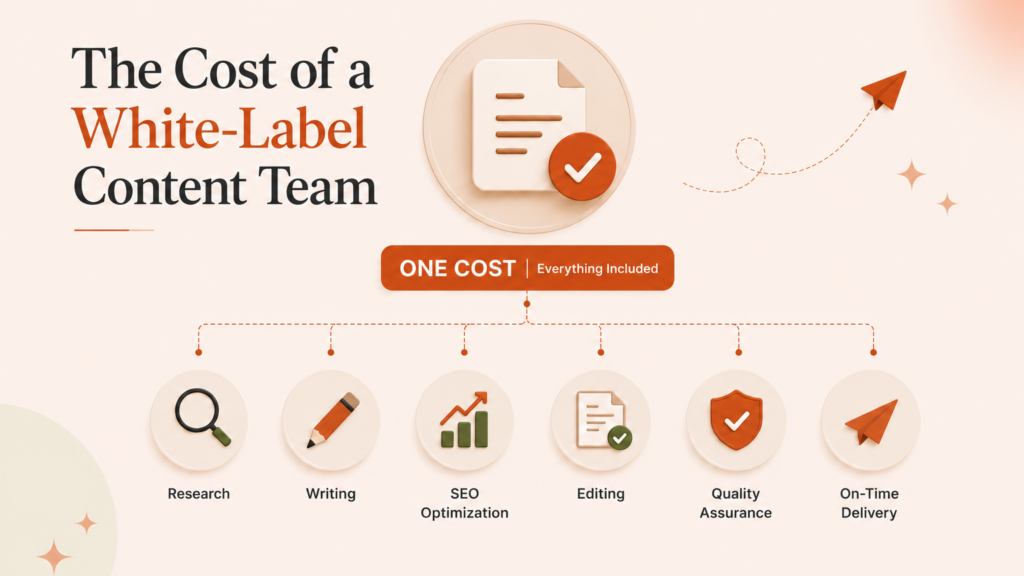
Pricing varies by content type, length, complexity, and volume, so treat the ranges below as planning guides rather than quotes. Across the industry, individual blog posts commonly run from roughly fifty to several hundred dollars each, while larger assets such as white papers or long-form guides can reach a thousand dollars or more. Most partners offer subscription packages and volume discounts, which lower the per-piece cost as your order size grows.
The smarter way to think about cost is margin, not price. If you buy a well-optimized blog post wholesale and resell it inside a client retainer, the spread is your profit. Because white-label content carries no salary overhead, that margin is usually far healthier than what an in-house team can deliver at low volume. We are transparent about rates precisely so you can price your own packages with confidence. You can talk pricing and packages directly with our team whenever you are ready.
Is White-Label Content Marketing Right for Your Agency?
White-label content is not for everyone, and we would rather you make the right call than the fast one. It tends to be the right move when one or more of these signals show up.
- Your team is maxed out and burnout is creeping in.
- You are turning down work because you lack the capacity to deliver.
- Quality is slipping as you try to scale volume with the same people.
- You spend more time managing writers than growing the agency.
- Clients want niches your in-house team cannot credibly cover.
If two or more of those hit home, a white-label content marketing partner is very likely worth a conversation. If your content volume is tiny and occasional, a freelancer may serve you fine for now. The framework is simple: outsource production when delivery becomes the bottleneck to growth, and keep it in-house when volume is stable and large enough to justify the payroll.
Frequently Asked Questions
Is white label content marketing legal?
Yes. White labeling is a legal, widely accepted business practice across the marketing industry. On payment, content rights transfer to you, and a professional partner is bound by confidentiality, so you can resell the work under your own brand without any legal issue.
What is the difference between white label and outsourcing?
Outsourcing simply means hiring an outside party to do work. White labeling is a specific type of outsourcing where the outside party stays anonymous and you rebrand the deliverable as your own. All white labeling is outsourcing, but not all outsourcing is white label.
Will my clients know I used a white label agency?
No. A genuine white-label partner is invisible to your clients by design. The content ships unbranded, the partner never contacts your client, and confidentiality is contractual. Your agency keeps the relationship and the credit.
How is white label content different from AI content?
AI content is generated by software and usually needs heavy editing, fact-checking, and strategy to be client-ready. White label content is produced by professional writers and editors, often specialists, who add research, brand voice, and optimization that raw AI output lacks. The strongest partners use AI to assist, not replace, human expertise.
Can a white label agency match our brand voice?
A capable partner can. During onboarding you share a style guide, tone notes, and example content, and the partner assigns writers who can adapt to it. Voice matching is one of the clearest ways to tell a premium white-label agency from a commodity one.
How quickly can I start reselling content?
With a prepared brief and brand guidelines, many agencies receive their first drafts within days of onboarding. Turnaround per piece then depends on length and complexity, though a dedicated white-label partner is built to hit the tight deadlines agencies live with.
The Bottom Line: Grow Without Outgrowing Your Team
A white-label content marketing agency lets your agency deliver more, better content under your own brand, without the cost and risk of building a large in-house team. You keep strategy and the client relationship. A specialist partner handles production, quality, and optimization for search and AI. Done well, it is one of the cleanest ways to scale delivery and protect margin at the same time.
We built ContentManics to be exactly that kind of partner: a quiet, dependable content engine behind your brand, producing SEO, AEO, and GEO-ready content your clients will happily pay for. If you are weighing your options for the best white label content partner, explore our white-label content marketing services, browse the ContentManics blog for more playbooks, or book a quick call and we will show you real samples in your clients’ niches.
| READY WHEN YOU ARE Tell us about your agency, your clients, and where delivery is getting stuck. We will map a content plan you can resell with confidence.No pressure, no jargon, just a straight conversation about scaling your content without scaling your headache. |

Leave a Reply