
White-label content is usually priced in one of two ways: per word (or per piece), where you pay a set rate for each deliverable, or on a monthly retainer, where you pay a fixed recurring fee for an agreed scope of work. Per-word pricing rewards flexibility and low commitment. Retainer pricing rewards volume, predictability, and priority. The right model for your agency depends on three things: how much content you resell, how stable your client demand is, and how much margin you need to protect.
We are ContentManics, a white-label AI-first content marketing agency, and we quote both of these models every week for agencies, SaaS teams, and Shopify brands who resell our work under their own logo. So we are going to write this from the inside. We will show you how each white-label content pricing model actually behaves once real clients, real revisions, and real deadlines enter the room, what each one typically costs in 2026, and how to choose the structure that keeps your margin healthy rather than quietly eating it.
| A note from our team: The headline rate is the least interesting number in any white-label quote. What you really buy is a pricing model, and the model decides your predictability, your scope control, your cash flow, and the ceiling on how many clients you can serve before the wheels come off. Read this guide for the model, not the sticker price. |
What white-label content pricing actually means
White-label content pricing is the rate structure a production partner uses to charge an agency or brand for content that will be resold or published under the buyer’s own name. Because the buyer never reveals the source, that price quietly becomes the buyer’s cost of goods sold. Whatever you pay your white-label partner is the floor under every price you quote your own clients.
That is why this decision carries more weight than most agency owners give it. You are not just choosing how to pay. You are setting the wholesale cost that your entire retail markup sits on top of. Get the model right and you have a repeatable engine with clean margins. Get it wrong and you spend your evenings reconciling one-off invoices, chasing revisions you did not budget for, and wondering why a healthy-looking markup keeps shrinking by the time cash actually lands.
Why the model matters more than the price
Two providers can quote the same effective rate and still leave you with wildly different businesses. One bills you per word with no commitment, which feels cheap until your busiest client sends four revision rounds and a rush request in the same week. The other bills you a flat monthly retainer, which feels expensive in a slow month and looks like a bargain in a busy one. The words might cost the same. The operating experience does not. Before you compare numbers, it helps to see exactly how each model works.
Per-word and per-piece pricing explained

Per-word pricing charges a fixed rate for every word delivered, while per-piece (or per-project) pricing charges a flat rate for a whole asset such as a blog post, a landing page, or an email. Both are transactional. You pay only for what you order, at the moment you order it, with no ongoing commitment.
How per-word and per-piece pricing works
The workflow is simple and order-driven, which is a big part of the appeal:
- You send a brief for a specific asset, or a batch of them.
- The partner quotes a rate per word or a flat rate per piece.
- You approve, the content is produced, and you pay for that order.
- The relationship resets to zero until your next brief.
There is no floor, no monthly minimum, and no obligation to come back. For an agency testing the waters or handling occasional overflow, that freedom is genuinely valuable.
What per-word and per-piece pricing typically costs
White-label blog posts commonly land anywhere from about $50 to $500 per post, and the effective per-word rate drops as your monthly volume climbs. The number is driven far more by research intensity and editorial rigor than by raw length. A lightly researched 800-word post and a deeply researched, expert-reviewed, source-cited 800-word post can sit at opposite ends of that range even though the word count is identical. When per-piece content is added on top of an SEO package rather than built into it, individual posts often run in the $200 to $400 range each, which is where a tidy base retainer quietly turns into a much larger bill.
| Insight: If a per-word quote looks unusually cheap, the missing line item is almost always editing. A rate that only covers a raw draft is not a bargain once you factor in the hours your own team spends fixing it. We build the senior human editing layer into the price on purpose, because an unedited draft is not a finished deliverable. |
Where per-word pricing wins
- Low commitment. No minimums, no lock-in, nothing to cancel. Ideal for testing a new partner or a new niche.
- Pay only for what you use. In a slow month, you spend nothing.
- Simple markup math. You know the exact cost of a single asset, so you can mark up cleanly per unit.
- Perfect for overflow. When your in-house team is briefly underwater, per-piece help absorbs the spike without a contract.
Where per-word pricing quietly costs you
This is the part agencies feel before they can name it. Per-word looks like the cheap option on the quote, then behaves like the expensive one in practice:
- Scope creep by revision. Every extra revision round, brief clarification, or tone tweak is either billed on top or absorbed by your own time. Neither is free.
- Unpredictable cash flow. Your content costs swing with client demand, which makes forecasting and quoting your own retainers harder.
- You queue behind everyone else. With no ongoing commitment, you have no priority. Rush weeks are exactly when per-piece partners are slowest.
- Admin grows with every order. Each brief is a fresh negotiation, a fresh invoice, and a fresh onboarding of context. That coordination is real labor that never appears on the invoice.
- Quality drifts. Order-by-order work rarely learns your brand voice deeply, so consistency across a client’s content library suffers.
Retainer pricing explained
A content retainer is a fixed monthly fee for an agreed scope of work, such as a set number of blog posts, emails, or strategy hours delivered every month. You are not buying a stack of individual orders. You are buying reserved capacity and an ongoing relationship, which is a fundamentally different thing.

How the retainer model works
Instead of quoting each asset, the partner reserves a block of production capacity for you every month and agrees on what that block delivers. A typical white-label content retainer might cover a defined number of blog posts, a set of social assets, an email sequence, and a fixed pool of strategy hours, all wrapped into one predictable fee. Because the relationship is continuous, briefs get faster, brand voice gets sharper, and the back-and-forth shrinks month over month. The partner is no longer a vendor you re-explain yourself to. They start to operate like an extension of your team.
What content retainers typically cost
Retainer pricing varies enormously by scope, which is exactly why blanket price comparisons mislead people. On the client-facing side, survey data shows a large share of agencies (around 38%) billing between $1,001 and $2,500 per month, while full-service B2B content programs commonly run $5,000 to $15,000 monthly and can climb far higher for embedded, team-style engagements. On the white-label wholesale side, per-client content retainers frequently sit somewhere between $500 and $5,000 depending on volume, complexity, and how much editing and strategy is baked in. A basic package sits near the floor. A comprehensive, multi-format, multilingual program sits near the top.
| The pattern we see: Volume unlocks better rates. Agencies that commit to steady monthly output routinely negotiate meaningfully lower effective rates than one-off buyers, and longer commitments often shave off more. If you are reselling content every month anyway, per-piece pricing usually means you are paying a premium for flexibility you are not actually using. |
Where retainers win
- Predictable cost. The same line item every month makes your own pricing, forecasting, and margins clean.
- Lower effective unit cost. Committed volume almost always lowers the price per piece.
- Priority and speed. Reserved capacity means faster turnaround, especially in the crunch weeks.
- Strategy is usually included. You get a roadmap, briefs, and optimization, not just words.
- Deeper brand-voice learning. A continuous partner compounds context, so quality rises over time instead of resetting every order.
Where retainers get risky
Retainers are not automatically the smart choice. Their weakness is the mirror image of their strength: rigidity.
- You pay whether you use it or not. If a client goes quiet, the retainer still bills. Unused capacity usually expires rather than rolling over.
- Priorities shift, scope does not. In real agency life, client needs change constantly, and rigid scope means renegotiating instead of redirecting.
- Minimum commitments. Many retainers lock you in for three to six months before you can cancel, so quality has to be verified early.
- The commodity trap. Clients who assume monthly means discounted can push margins down if the value is not framed around priority and continuity.
We say this openly because we would rather you start on the model that fits. A retainer only pays off when the demand behind it is real and recurring. If it is not yet, a smaller retainer or a hybrid is the honest answer, and we will tell you so on the call.
Per-word vs retainer: the side-by-side comparison
Here is the whole decision in one view. Read it as a diagnostic, not a verdict, because the right column depends entirely on your own demand pattern.
| Factor | Per-Word / Per-Piece | Monthly Retainer |
|---|---|---|
| Billing basis | A set rate per word or a flat rate per finished asset. | One fixed fee each month for an agreed scope. |
| Commitment | None. You order only when you need to. | Ongoing, often with a 3 to 6 month minimum. |
| Predictability | Low. Spend rises and falls with orders. | High. The same line item every month. |
| Effective unit cost | Higher per piece at low volume. | Lower per piece once volume is steady. |
| Priority and turnaround | You queue behind retainer clients. | Reserved capacity and faster turnaround. |
| Strategy included | Rarely. You buy words, not a roadmap. | Usually. Strategy and briefs are built in. |
| Scope control | Clean per order, but revisions add up. | Defined monthly, but rigid when needs shift. |
| Cash flow | Variable and hard to forecast. | Stable and easy to forecast. |
| Scaling | Admin grows with every new order. | Scales smoothly as a repeatable system. |
| Best for | Spiky, unpredictable, low-volume demand. | Steady, recurring, multi-client demand. |
| Main risk | Scope creep and quality drift. | Paying for capacity you did not use. |
The hidden costs neither model prints on the invoice
The most expensive part of a white-label relationship is often the part that never appears on the quote. Whichever pricing model you choose, budget for these, because they are the difference between the margin you think you have and the margin you actually keep:
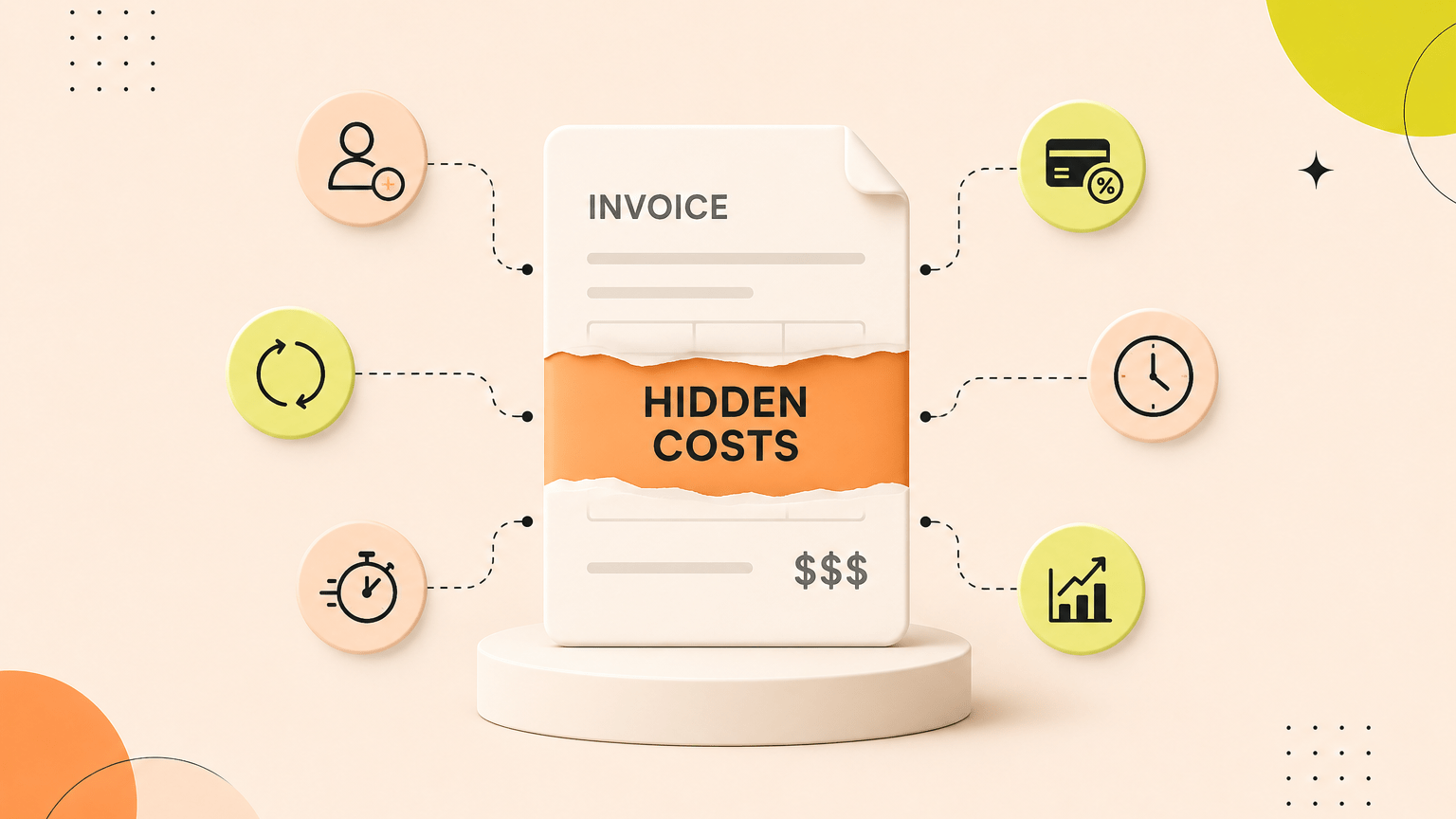
- Setup and onboarding fees. Many providers charge a one-time fee, often in the $500 to $2,500 range, for audits, access setup, and strategy groundwork. Either bill it to your client or spread it across the first months so month one is not underwater.
- Revision limits. Most contracts include a set number of revision rounds. Anything beyond that is billed, and unlimited revisions quietly bleed margin on both sides.
- Rush and out-of-scope fees. Expedited work, weekend coverage, and specialized formats often carry premium rates that only surface when you are already in a hurry.
- Payment processing. Card and transfer fees take roughly 3% off the top. On a $3,000 retainer that is about $90 a month, every month, across every client.
- Your own management time. Writing briefs, reviewing drafts, consolidating client feedback, and coordinating revisions are agency-side hours. At an internal cost of $75 to $150 an hour, a few hours per account per month can erase a third of the margin your invoice math promised.
| Why this matters for model choice: A cheap per-word rate paired with a weak editor forces your team to rewrite, which is the most expensive hidden cost of all. A slightly higher retainer that ships genuinely publish-ready content usually wins on total cost, because the hours you do not spend fixing drafts are hours you can sell. This is precisely why we run every asset through a senior human editor before it reaches you. |
The hybrid model: Base retainer plus per-deliverable add-ons
A hybrid model combines a smaller base retainer, which covers strategy, briefs, and a core deliverable set, with per-piece add-on pricing for anything extra. It gives the partner predictable baseline revenue and gives you flexibility for spiky demand, which is why it has quietly become the most practical structure for agencies with uneven client rosters.
In practice a hybrid looks like a modest monthly fee that guarantees your strategy layer, brand-voice continuity, and priority access, plus a clear per-asset rate for overflow, one-off campaigns, or a client who suddenly wants twice the usual output. You get the predictability and priority of a retainer for your baseline, and the pay-as-you-go flexibility of per-piece for the peaks. For most growing agencies, this is the model that protects margin without punishing a slow month.
How to choose the right white-label content pricing model
Skip the abstract debate and match the model to your actual demand pattern. Here is the short version.
Choose per-word or per-piece pricing if
- Your demand is spiky, occasional, or hard to predict.
- You are testing a new partner or a new niche before committing.
- You only need overflow help a few times a quarter.
- You want zero lock-in while you validate quality.
Choose a monthly retainer if
- You resell content every single month across one or more clients.
- You want predictable costs so you can quote your own retainers with confidence.
- You value priority turnaround and a partner who learns your brand voice.
- You want strategy and optimization included, not billed as extras.
Choose a hybrid if
- You have a steady baseline plus unpredictable peaks.
- You want the strategy layer locked in but the volume flexible.
- You are scaling and your client roster changes month to month.
How your pricing model shapes your margin as a reseller
This is the part that decides whether white-label content is a profit engine or a treadmill. Your margin is never just retail price minus wholesale cost. It is retail price, minus wholesale cost, minus your own labor. Here is the math agencies most often get wrong.
Say you charge a client $2,500 a month for content and pay your partner $1,000. On paper that looks like $1,500 of margin. Now subtract your real time: brief writing, draft review, client feedback loops, and revision coordination. If that adds up to a few hours a month at an internal cost of $150 an hour, your true margin is closer to $975 than $1,500. The surface number lied by roughly a third. The single biggest lever on that hidden cost is how much rework the content needs. A partner who ships publish-ready drafts protects your margin. A partner who ships raw first drafts hands you a second job.
This is where the white-label content pricing model and the quality model collide. A retainer with a serious editing layer keeps your review time low and your margin intact. A cheap per-word rate with no editing looks better on the quote and worse on the bank statement. When we talk with partners about complete blog production or scaled content production, the conversation is always about total cost to publish, not cost per word, because that is the number that actually lands in your account.
How AEO and GEO are changing the pricing conversation in 2026
Content pricing is shifting away from cost per word and toward cost per asset that can rank on Google and get cited by answer engines. As buyers optimize for AI Overviews, ChatGPT, Perplexity, Claude, and Gemini, the value of a piece is no longer its length. It is whether the piece can be quoted, surfaced, and trusted. That quietly makes pure per-word pricing feel outdated, because it prices the one thing that matters least.
Answer Engine Optimization (AEO) and Generative Engine Optimization (GEO) reward structure that a word count cannot capture: answer-first paragraphs, clear definitions, semantic entity coverage, citation-friendly formatting, and schema-ready headings. Content built this way is worth more per asset and cheaper per result, which is exactly the argument for value-based and retainer pricing over per-word billing. We treat AEO and GEO as the default way we write, not an upsell, because in 2026 that is what separates content that ranks from content that just fills a calendar.
How ContentManics prices white-label content
We price around outcomes, not word counts. Most of our agency partners start on a monthly retainer that already includes strategy, brief construction, AI-assisted drafting, a senior human editing pass, and AEO and GEO optimization, all shipped fully unbranded and ready to publish under your name. Pricing scales with volume, complexity, and editing depth, and we offer a hybrid structure for partners whose demand has a steady base and unpredictable peaks.
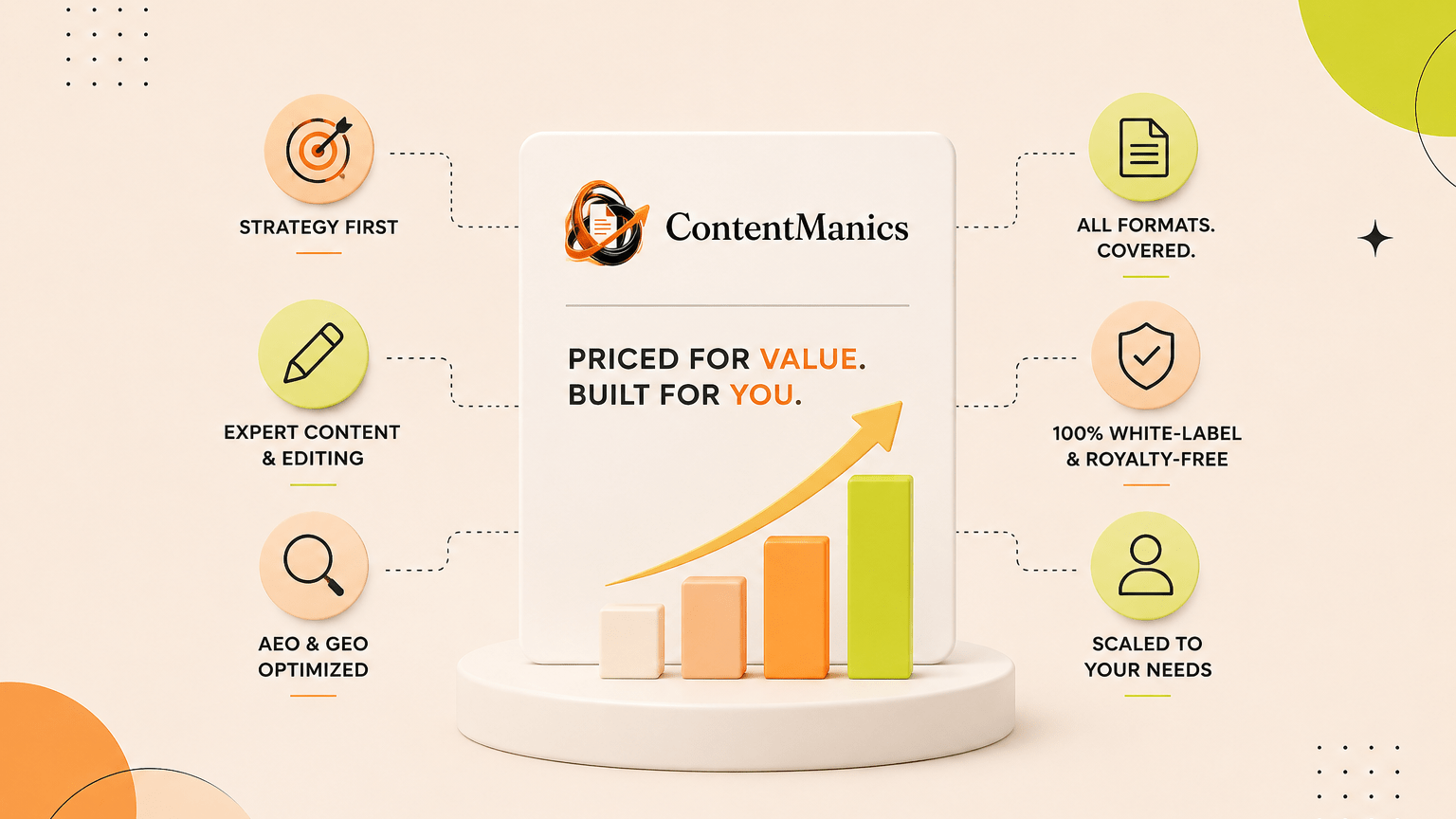
What every model we quote has in common:
- Strategy first. Every asset starts from a brief grounded in positioning, keyword cluster, and search intent. See our content marketing strategy service.
- A human editor on every asset. Nothing reaches you as a raw draft, so your review time and rework cost stay low.
- AEO and GEO by default. Structured to be cited by answer engines, not just indexed by Google.
- Full format coverage. From blog production to email marketing content and social content and repurposing, run one or run them as a complete engine.
- Zero bylines. Every piece ships unbranded and royalty-free. Your clients see your brand from brief to publish.
If you want to see the numbers for your own volume, our pricing page lays out how retainers and add-ons are structured, and a quick discovery call turns that into a tailored quote for your first sprint. Not ready to talk pricing yet? Start with a free content audit and we will show you where your current content is leaking margin and ranking potential before you commit to anything.
Frequently asked questions
Is per-word or retainer pricing better for white-label content?
Retainer pricing is usually better if you resell content every month, because it lowers your effective unit cost, adds priority turnaround, and includes strategy. Per-word or per-piece pricing is better for occasional, unpredictable, or overflow work where you want no commitment. Many growing agencies land on a hybrid of the two.
How much does white-label content cost per word or per post?
White-label blog posts commonly range from about $50 to $500 per post, with the effective per-word rate falling as monthly volume rises. Research depth and editing rigor drive the price far more than raw length, so two posts of the same word count can sit at very different rates.
What is a typical white-label content retainer?
On the wholesale side, per-client white-label content retainers often run between $500 and $5,000 per month depending on volume, formats, languages, and editing depth. Client-facing full-service B2B content programs commonly sit between $5,000 and $15,000 monthly.
Do content retainers include strategy?
Usually yes. A retainer typically bundles strategy, briefs, production, editing, and optimization into one fee, which is a core reason its effective value beats buying words on their own. Per-word arrangements rarely include a strategy layer.
What hidden fees should agencies watch for?
Watch for one-time setup or onboarding fees (often $500 to $2,500), revision rounds beyond the included limit, rush and out-of-scope charges, payment processing of roughly 3%, and your own management time for briefing and review, which is the cost most agencies forget to count.
Can I switch from per-word to a retainer later?
Yes, and most agencies do. A common path is to start per-piece to validate a partner’s quality, then move to a retainer or hybrid once demand becomes steady and you want lower unit costs plus priority. We are happy to start you wherever your demand actually is today.
Does AI-generated white-label content cost less?
AI can lower base production cost and speed, but the value still depends on human editing, fact-checking, and brand alignment. The formula that ranks and stays safe for SEO is AI-assisted drafting plus a senior human editor, which is exactly how we produce every asset.
Resell white-label content under your brand, priced to protect your margin
Choosing between per-word and retainer pricing is really a question about your own demand and your own margin, not about which model is universally best. If your content demand is real and recurring, a retainer or hybrid almost always wins on total cost to publish. If it is occasional, per-piece keeps you flexible. Either way, the partner behind the price is what determines whether that margin survives contact with real clients.
ContentManics already runs the strategy, drafting, human editing, and AEO and GEO layer behind agencies, SaaS brands, and enterprise teams in 14 countries, all fully white-labeled. You can have the same engine running under your logo, priced to your volume. Book a discovery call or see our pricing, grab a free content audit, or keep reading on the ContentManics blog.




Leave a Reply