
If you have ever paused before hitting publish on an article your team did not write in-house, you are not being paranoid. You are being responsible. The question “is white-label content ethical?” sits quietly behind almost every outsourcing decision, and it deserves a real answer instead of a shrug.
We will be upfront about our vantage point. At ContentManics, we produce white-label content for agencies, SaaS brands, and enterprise teams every single day, and we ship all of it without ever claiming a byline. So we have wrestled with this question more than most. The short version: white-label content is ethical when three things are handled with care. Ownership transfers cleanly, the byline reflects genuine accountability, and disclosure stays honest wherever a reader could reasonably feel misled. Get those three right and you are on firm ground. Get them wrong and even fully original content can slide into deception.
Let us walk through exactly where the lines sit, so you can outsource with a clear conscience and a position you can defend to a client, a regulator, or a skeptical reader.
What Does “White-Label Content” Actually Mean?
White-label content is written material, such as blog posts, landing pages, emails, and social copy, that one company produces for another company to publish under its own brand. The producing partner stays invisible. The publishing brand keeps the byline, the credit, and full ownership of the asset.
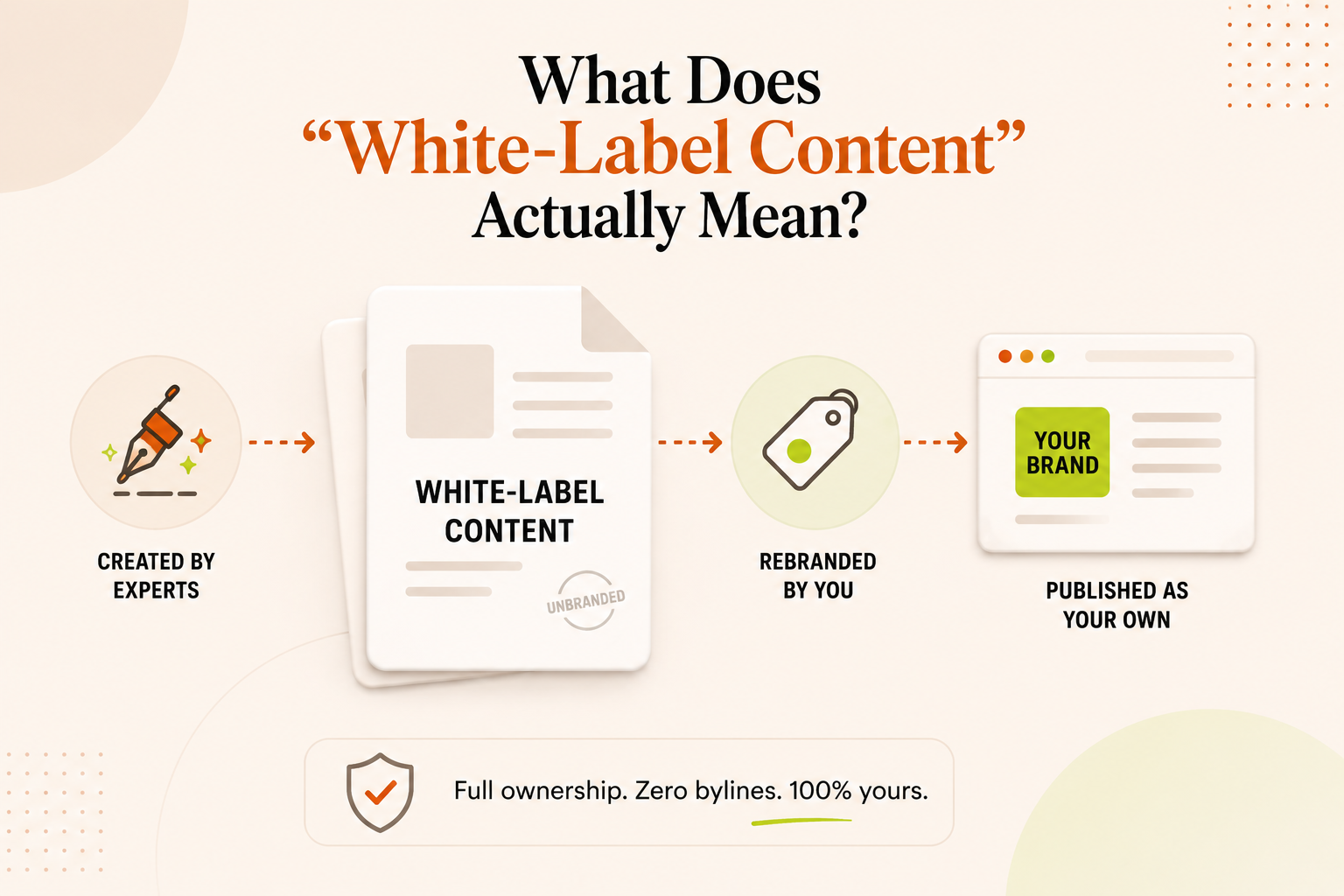
Think of it the way retailers think about house-brand products. A manufacturer builds an item to a specification, and the store sells it under its own label. Nobody feels deceived when a supermarket sells its own brand of olive oil, because the store stands behind the product and takes responsibility for its quality. White-label content runs on the same logic. We build the asset to your brief, in your voice, and hand it over. From that moment, it is yours to stand behind.
This is a normal, long-standing practice across content marketing. What makes it feel murky is that content carries a name, and a name implies authorship. That is precisely where ethics enters the picture, and it is what the rest of this article untangles.
White-Label Content vs Ghostwriting vs Plagiarism
These three terms get tangled together constantly, so let us separate them cleanly, because the ethics of each are genuinely different.
- White-label content: original work produced by a partner and published under a brand’s name, with ownership formally transferred. The brand directs strategy and stands behind the message.
- Ghostwriting: writing in a specific named person’s voice and point of view, usually after interviews, so the piece reads as if that person wrote it. True ghostwriting is collaborative, and the named author reviews and approves the final draft.
- Plagiarism: passing off someone else’s existing, protected work as new and original without permission or licensing. It is theft, and it is never ethical.
Here is the line that matters. White-label content and ghostwriting both involve a hidden writer, but the work is original and the arrangement is consensual and paid. Plagiarism involves stolen work. Confusing the first two with the third is the single biggest reason people wrongly assume white-label content is dishonest by default. It is not.
So, Is White-Label Content Ethical? The Honest Answer
Yes. White-label content is ethical in the vast majority of marketing contexts, as long as the publishing brand is genuinely involved in the content and takes real responsibility for it. Ethics does not hinge on who typed the words. It hinges on whether the published brand actually owns the ideas, the accuracy, and the accountability.
The most useful ethical test comes from a place you might not expect: the long-running legal and academic debate over ghostwriting. The broadly accepted consensus is that if the party publishing under their name still takes part in shaping the content, the arrangement is ethical. If that party has zero involvement and simply attaches their name to words they never engaged with, it drifts toward deception. Even the American Bar Association has formally accepted ghostwritten legal filings, provided the proper disclosures are made. When a profession as risk-averse as law signs off on the practice, the marketing version is hardly a scandal.
Bring that principle into content marketing and the answer becomes clear. When your brand sets the strategy, approves the brief, reviews the draft, and vouches for the claims, you are the genuine author in every sense that matters to a reader. We wrote the sentences. You own the message. That is not a loophole. It is how nearly all professional communication has always worked, from corporate blogs to CEO keynotes to a president’s speeches. The speechwriter is invisible on purpose, and no reasonable listener feels lied to.
The “Involvement” Principle That Separates Ethical From Unethical
Involvement is the hinge the whole question turns on. The more your brand engages with white-label content, the more clearly ethical it becomes. The less you engage, the more you expose yourself to reputational and factual risk. Here is the spectrum in plain terms:
- Clearly ethical: you define the strategy and audience, approve the outline, review the draft, and take responsibility for accuracy before anything goes live.
- Gray zone: you order content in bulk, skim it, and publish without meaningful review.
- Ethically risky: you publish content you have never read, on claims you cannot verify, under a named human author who had no hand in it.
Notice that the risk is never “someone else wrote it.” The risk is publishing something you cannot stand behind. This is exactly why our production model is built strategy-first, with a senior human editor on every asset. It is also why we lead with a documented content marketing strategy before a single word gets drafted, so involvement is designed in rather than hoped for.
Who Really Owns White-Label Content? (Ownership and Copyright)
In a properly structured white-label arrangement, the publishing brand owns the content outright. Ownership transfers through a work-for-hire agreement or an explicit copyright assignment, which means the words, the rights, and the reuse permissions all belong to you the moment the asset is delivered.
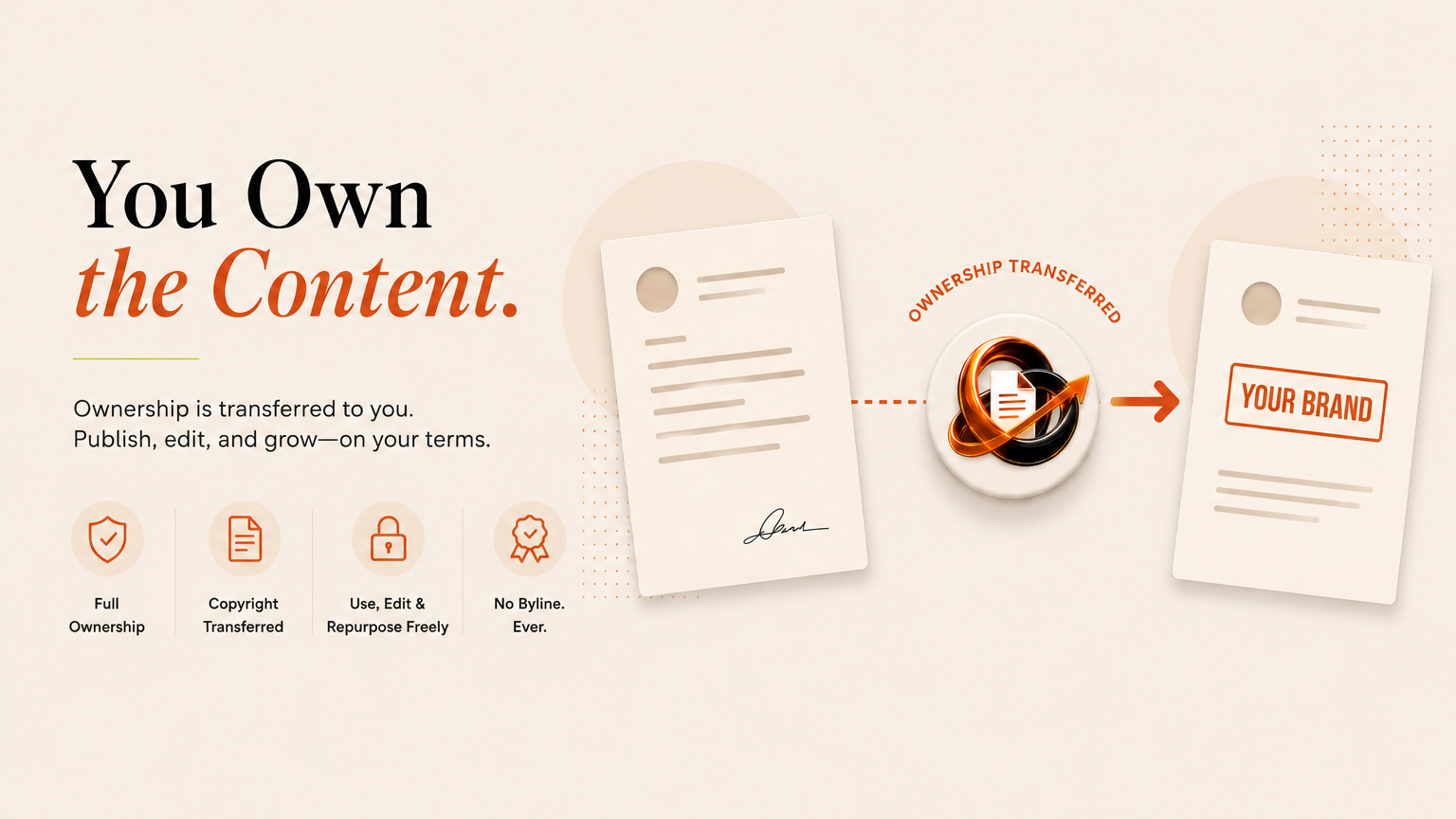
This is the part that quietly resolves most ethical anxiety. When ownership transfers cleanly, you are not pretending the content is yours. It is legally and contractually yours. There is no hidden true author with a competing claim, because that claim was assigned to you as part of the deal. The invisibility of the writer is a feature you paid for, not a secret you are keeping.
A trustworthy white-label partner makes this explicit rather than assumed. Every piece we ship is unbranded, royalty-free, and yours to publish, edit, repurpose, or retire as you see fit. We claim zero bylines, by design. If a partner is vague about ownership, treat that as your signal to ask harder questions before a single asset goes live. When you evaluate any partner, including us, ownership terms should be written into the engagement and pricing, not left to a handshake.
Work-for-Hire and Why the Byline Legitimately Becomes Yours
Work-for-hire is the mechanism that makes a byline honest. Under a work-for-hire or assignment arrangement, the commissioning brand is treated as the author and owner for practical and legal purposes. The writer relinquishes any claim to authorship credit as part of the paid agreement. Nothing is being taken that was not freely and knowingly given.
This is worth sitting with, because it reframes the byline question entirely. A byline is not a sworn statement that one specific human physically typed every word. In marketing and corporate publishing, a byline signals who is accountable for the content and who stands behind it. When your brand, or a real subject-matter expert on your team, owns and endorses the piece, the byline is accurate in the way that actually matters to readers.
The Byline Question: Is Publishing Under Your Own Name Dishonest?
Publishing white-label content under your own brand name is not dishonest, because a brand byline communicates accountability, not physical authorship. It becomes dishonest only when a specific, named individual is credited as the sole author of expertise or experiences they do not actually have.
Here is where we ask teams to slow down and think about the reader. Most readers already understand, at least implicitly, that a company blog is a team effort. When “Acme Marketing” publishes a guide, no reasonable reader believes a single person named Acme sat down and wrote it. The brand is the author. That is honest, and it always has been.
The ethics tighten the moment you attach a real person’s name and imply first-hand expertise. If you byline an article to “Dr. Jane Smith, Chief Medical Officer” and fill it with clinical experiences Dr. Smith never had and never reviewed, now you have a genuine problem. The issue is not that a writer helped. The issue is that you are manufacturing credibility that does not exist. That is the difference between real ghostwriting, which is collaborative and approved by the named author, and “slap a name on it” publishing, which is not.
| A ContentManics note. This is why we build a review step into the workflow rather than treating it as optional. A named expert should be able to defend every claim under their byline in a room full of skeptics. If they cannot, the byline, not the outsourcing, is the ethical problem. Fix the accountability and the credit takes care of itself. |
When Do You Actually Need to Disclose White-Label Content?
You generally do not need to disclose that marketing content was produced by a white-label partner, because promotional content is already understood to be the brand’s own advocacy. Disclosure becomes necessary when content presents itself as independent, such as reviews, endorsements, and testimonials, or when a material relationship would change how a reader weighs the message.
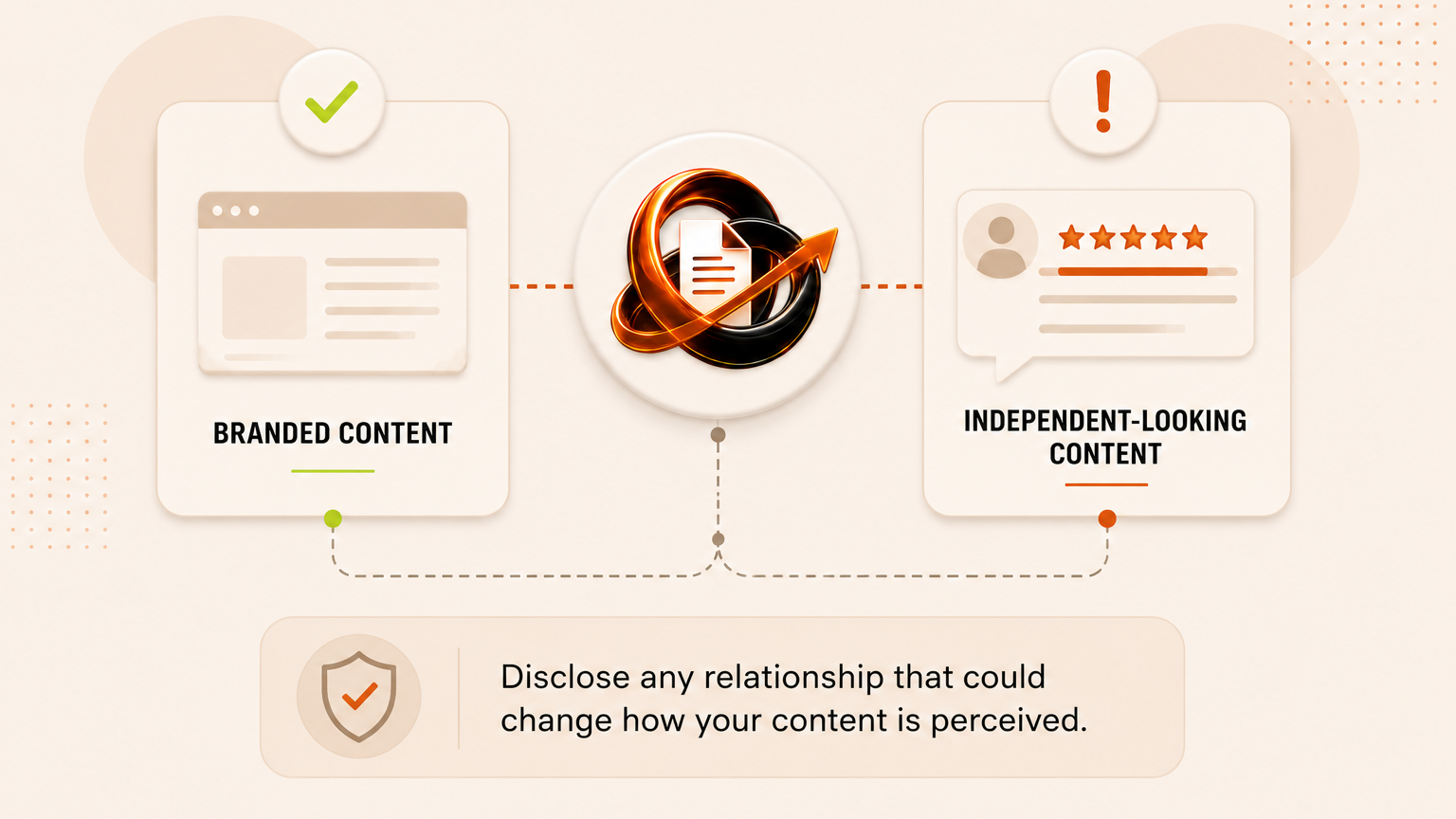
This is the question that makes people nervous, and it is where a lot of well-meaning marketers over-worry about the wrong thing while under-thinking the thing that matters. Let us separate the two.
Nobody expects a footnote on your company blog announcing that a contractor helped write the post. Readers already assume your marketing is your marketing. Requiring a disclosure for every outsourced blog would be like requiring a law firm to disclose that a paralegal drafted the first version of a brief. It is a normal division of labor, not deception. What regulators and reasonable readers actually care about is a hidden material relationship inside content that pretends to be neutral. That is a completely different animal.
What the FTC Endorsement Guides Do and Do Not Require
The FTC Endorsement Guides are the reference point in the United States, and they are narrower than most people assume. The guides target deception, not outsourcing. They call for a clear and conspicuous disclosure when there is a material connection between an endorser and a brand that a reader would not expect and would want to know about. The FTC defines that endorsement broadly, covering any message a reader is likely to believe reflects the views or experience of someone other than the advertiser.
In plain terms, the situations the FTC cares about look like these:
- A “review” or “testimonial” that reads as independent but was paid for or written by the seller.
- An endorsement where the endorser has an undisclosed financial or employment relationship with the brand.
- Fake reviews, incentivized reviews presented as organic, or AI-generated testimonials passed off as real customer experiences.
Notice what is not on that list. The FTC does not require you to announce that your own marketing blog was written with outside help. Your blog is openly your brand’s voice, so there is no hidden relationship to disclose. Everyone already knows the brand is speaking on its own behalf.
Marketing Content vs Editorial and Review Content: The Line That Matters
The cleanest rule we can give you is this: disclosure tracks the promise the content makes to the reader. Content that openly advocates for a brand needs no special disclosure. Content that implies independence, neutrality, or third-party experience needs honesty about any relationship that would change how it is read. Applied to real assets, that looks like:
- Your branded blog, landing page, email, or social caption: no white-label disclosure needed. It is your brand speaking, and everyone knows it.
- A commissioned review, comparison, or testimonial that appears independent: disclose the relationship clearly and conspicuously, right where the reader will see it.
- A named expert byline: make sure that expert genuinely reviews and stands behind the piece.
Follow that logic and you will almost never end up on the wrong side of a disclosure question. When in doubt, ask whether a reasonable reader would feel tricked if they learned the full story. If the answer is yes, disclose. If the answer is no, you are simply publishing your own marketing, which you are entitled to do.
The Gray Areas: When White-Label Content Crosses an Ethical Line
White-label content becomes unethical when it manufactures credibility, hides a material relationship, misrepresents experience, or publishes unverified claims. The problem is never outsourcing itself. It is deception layered on top of outsourcing.
We would be doing you a disservice if we pretended every use of white-label content is squeaky clean. It is not, and being able to name the failure modes is part of using it responsibly. Here are the ones we watch for on every engagement:
- Fabricated first-person expertise. Publishing “I performed this procedure” or “in my twenty years as a CPA” under a named author who has neither the procedure nor the twenty years. That is misrepresentation, full stop.
- Fake independent reviews. Commissioning content that poses as a neutral third-party review while hiding that you paid for it or sell the product. This is the exact deception the FTC was built to police.
- Publishing unverified or false claims. Shipping content nobody fact-checked, especially in regulated spaces like health, finance, and legal, where a wrong claim can harm real people.
- Regulated advice without qualified review. In medicine, law, and finance, a human with the right credentials needs to stand behind the substance, not just lend a byline.
- Undisclosed AI slop at scale. Mass-publishing unedited AI output with nobody accountable for accuracy. The ethical failure here is the abdication of responsibility, not the tools.
Every one of these shares the same root cause: someone published something they were not willing or able to stand behind. Solve that, and the gray areas mostly disappear. Notice, too, that four of the five have nothing to do with white-labeling specifically. They are content-quality failures that happen to show up wearing an outsourcing costume.
How to Use White-Label Content Ethically: A Practical Framework
To use white-label content ethically, transfer ownership in writing, stay genuinely involved in strategy and review, verify every claim, reserve named-expert bylines for people who actually approve the work, and disclose any relationship in content that presents itself as independent.
None of this is burdensome. It is simply what responsible publishing looks like, and a good partner makes almost all of it effortless. Here is the field-tested checklist we hand to teams that want a clean conscience and a defensible record:
- Get ownership in writing. Confirm work-for-hire or full copyright assignment so the content is legally yours from delivery.
- Stay involved. Set the strategy, approve the brief, and review the draft. Involvement is what makes the byline honest.
- Verify the claims. Fact-check statistics, quotes, and especially regulated claims before anything publishes.
- Match bylines to reality. Use a brand byline freely. Use a named human byline only when that human reviews and endorses the piece.
- Disclose independence honestly. If content looks neutral but is not, say so clearly and conspicuously, near the content itself.
- Keep a human accountable. Someone on your side should be able to defend every published asset without flinching.
If that list feels like a lot to enforce across dozens of clients or hundreds of assets a month, it is. That is the entire reason a production partner exists. When you scale content production the right way, these safeguards run inside the workflow instead of living on a sticky note you hope everyone remembers.
Does Ethical White-Label Content Still Help Your E-E-A-T and Rankings?
Yes. Ethical white-label content strengthens E-E-A-T and search performance, because the same practices that make it ethical, such as genuine involvement, verified claims, real expertise, and accountability, are exactly what Google and AI answer engines reward. Deceptive shortcuts are what get penalized, not outsourcing.
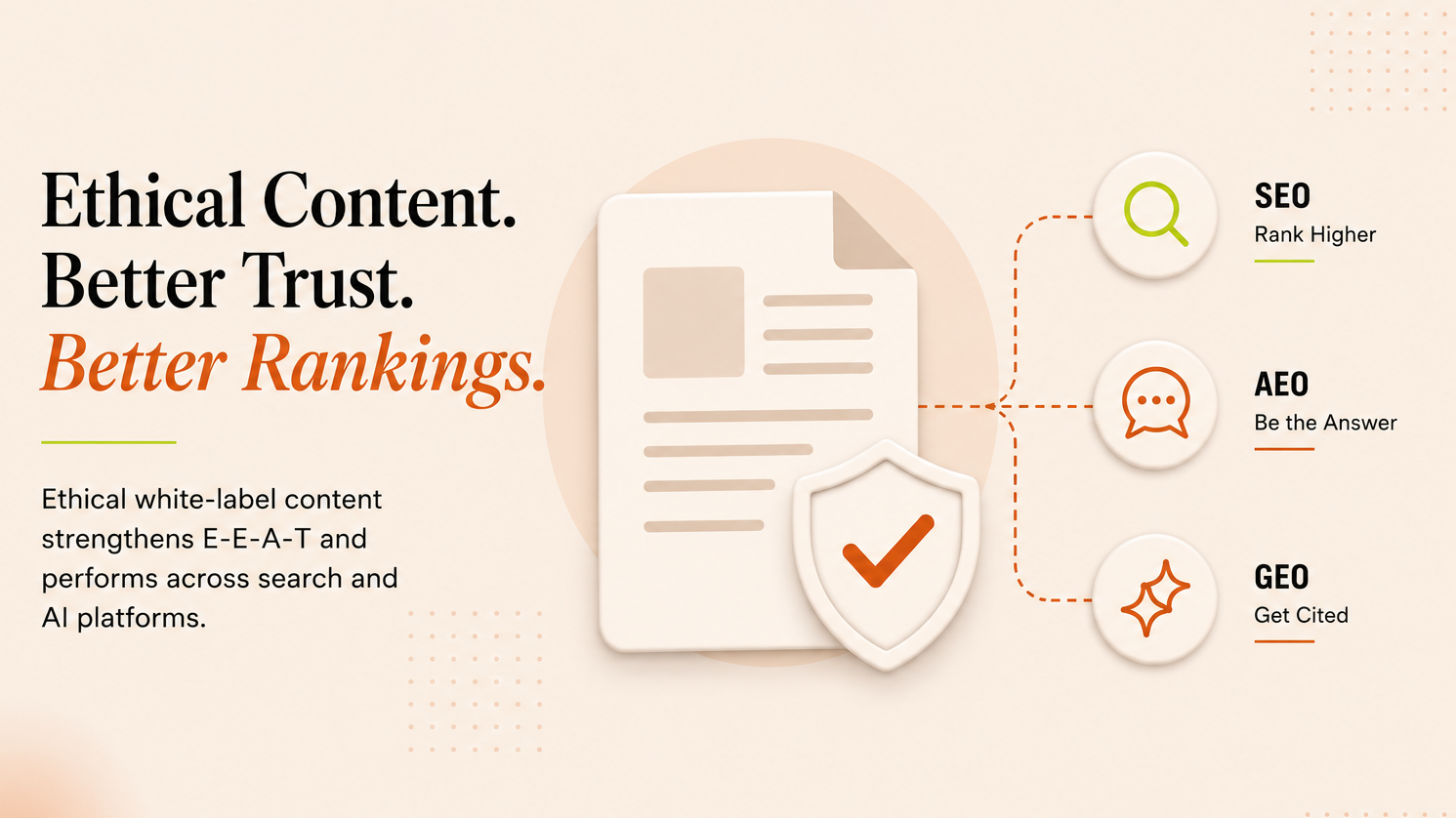
This is where ethics and results stop being a trade-off and start being the same thing. Google has been consistent that its problem is low-quality, unhelpful content, not the fact that content was assisted or produced by a partner. The signals that separate content that ranks from content that sinks, including first-hand expertise, accuracy, clear structure, and genuine helpfulness, are the same signals that make content honest. Ethical and effective turn out to be two words for one practice.
The connection runs even deeper in the age of answer engines. When you optimize for Answer Engine Optimization and Generative Engine Optimization, you are structuring content to be quoted by ChatGPT, cited by Perplexity, and lifted into Google AI Overviews. Those systems weigh trust markers heavily: clear definitions, verifiable claims, named expertise, and citation-friendly formatting. That is simply the machine-readable version of “content you can stand behind.” We build this in from the first draft, which is why our AI SEO, AEO, and GEO work makes the content that keeps you on the right side of the ethics line also the content most likely to be surfaced and cited.
How ContentManics Keeps White-Label Content Ethical by Design
ContentManics keeps white-label content ethical through four built-in safeguards: full ownership transfer with zero bylines claimed, strategy-first production, a senior human editor and fact-check on every asset, and AEO and GEO structuring that rewards genuine expertise. Ethics is not a policy we bolt on. It is how the workflow is designed.
We will be candid about why this matters to us. We built ContentManics as a white-label content partner precisely because we watched the content-mill version of this industry give outsourcing a bad name. Fast, cheap, unaccountable, and occasionally embarrassing for the brand whose name ended up on it. We wanted to prove the model could be the opposite. Here is how the ethical safeguards show up in practice:
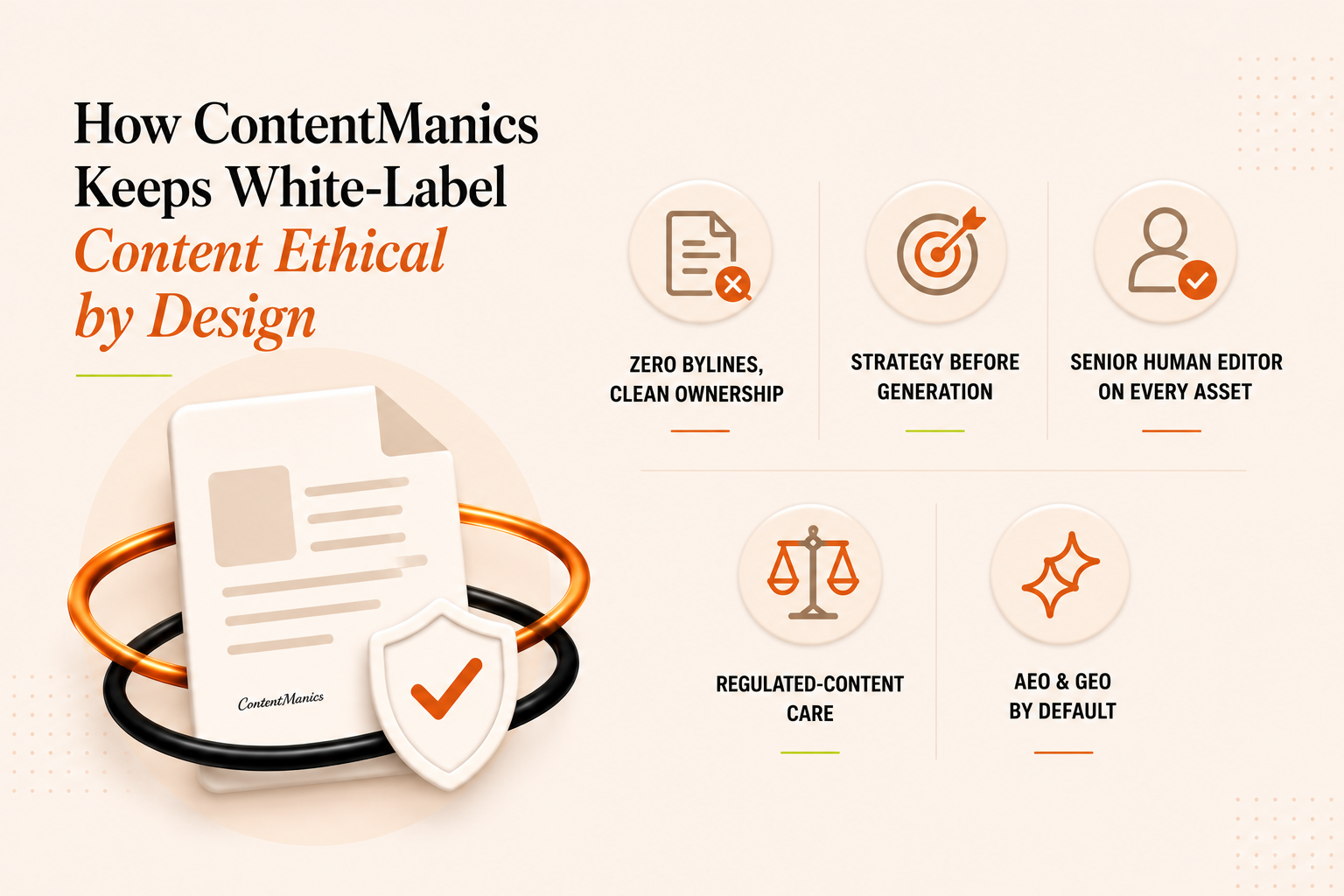
• Zero bylines, clean ownership. Every piece ships unbranded and royalty-free, ready for your name. We never claim authorship, and ownership is yours from delivery.
• Strategy before generation. Before a word is drafted, our strategists build a content marketing strategy grounded in your positioning, audience, and search intent, so the content genuinely reflects your brand rather than a generic template.
• A senior human editor on every asset. Real editors fact-check claims, remove AI tells, add primary examples, and run authenticity checks, which is the backbone of our complete blog production process, so nothing unverifiable reaches your client.
• Regulated-content care. In fintech, health, legal, and real estate, we never publish a regulated claim without human review and source citation. That is the accountability the ethics question is really asking about.
• AEO and GEO by default. We structure for answer engines, which means clear definitions, verifiable claims, and trust signals baked in through our AI SEO, AEO, and GEO coverage.
The result is content you can publish under your brand with a clear conscience, because the involvement, ownership, and accountability that make it ethical are already handled. The same discipline runs across everything we produce, from long-form articles to email marketing content and social media content and repurposing. If you want to see where your current content stands, our free content audit is a low-pressure place to start.
Frequently Asked Questions
-
Is white-label content the same as plagiarism?
No. Plagiarism is passing off someone else’s existing, protected work as your own without permission. White-label content is original work created for you, with ownership legally transferred, so publishing it under your brand is fully legitimate.
-
Do I legally own white-label content?
Yes, when the agreement includes work-for-hire or copyright assignment. In a properly structured white-label deal, the content, its rights, and its reuse permissions belong to you at delivery. Always confirm the ownership terms in writing before you publish.
-
Do I have to disclose that content was outsourced?
For standard branded marketing content, no. Readers already understand your marketing speaks for your brand. Disclosure is required when content presents itself as independent, such as reviews or testimonials, or when a hidden relationship would change how a reader weighs it.
-
Is it ethical to publish white-label content under a person’s name?
It is ethical when that named person genuinely reviews, approves, and stands behind the content. It becomes unethical if you attribute specific expertise or experiences the named author does not actually have.
-
Does the FTC prohibit white-label content?
No. The FTC Endorsement Guides target deceptive endorsements and undisclosed material relationships, not outsourced marketing content. Your own branded blog is openly your advocacy, so there is no hidden relationship to disclose.
-
Will white-label content hurt my SEO or E-E-A-T?
Not when it is done well. Google penalizes low-quality, unhelpful content, not outsourcing. Content with genuine expertise, verified claims, and clear structure supports E-E-A-T and performs in both search and AI answer engines.
-
How does ContentManics keep white-label content ethical?
We transfer full ownership and claim zero bylines, build strategy before drafting, put a senior human editor and fact-check on every asset, take extra care with regulated claims, and structure everything for AEO and GEO. Accountability is built into the workflow rather than added at the end.
The Bottom Line on Ethical White-Label Content
White-label content is not an ethical gray zone by nature. It is a normal, legitimate way to produce marketing at scale, and it stays ethical when ownership is clean, involvement is real, bylines are honest, and disclosure matches what the content promises the reader. Handle those four, and you can outsource production without ever outsourcing your integrity.
That is the standard we hold ourselves to on every asset we ship. If you would like to resell strategic content under your own brand, with the ethics handled by design, we would love to show you how it works. Explore our white-label content services, or start with a free content audit, and keep every byline for yourself.

Leave a Reply