
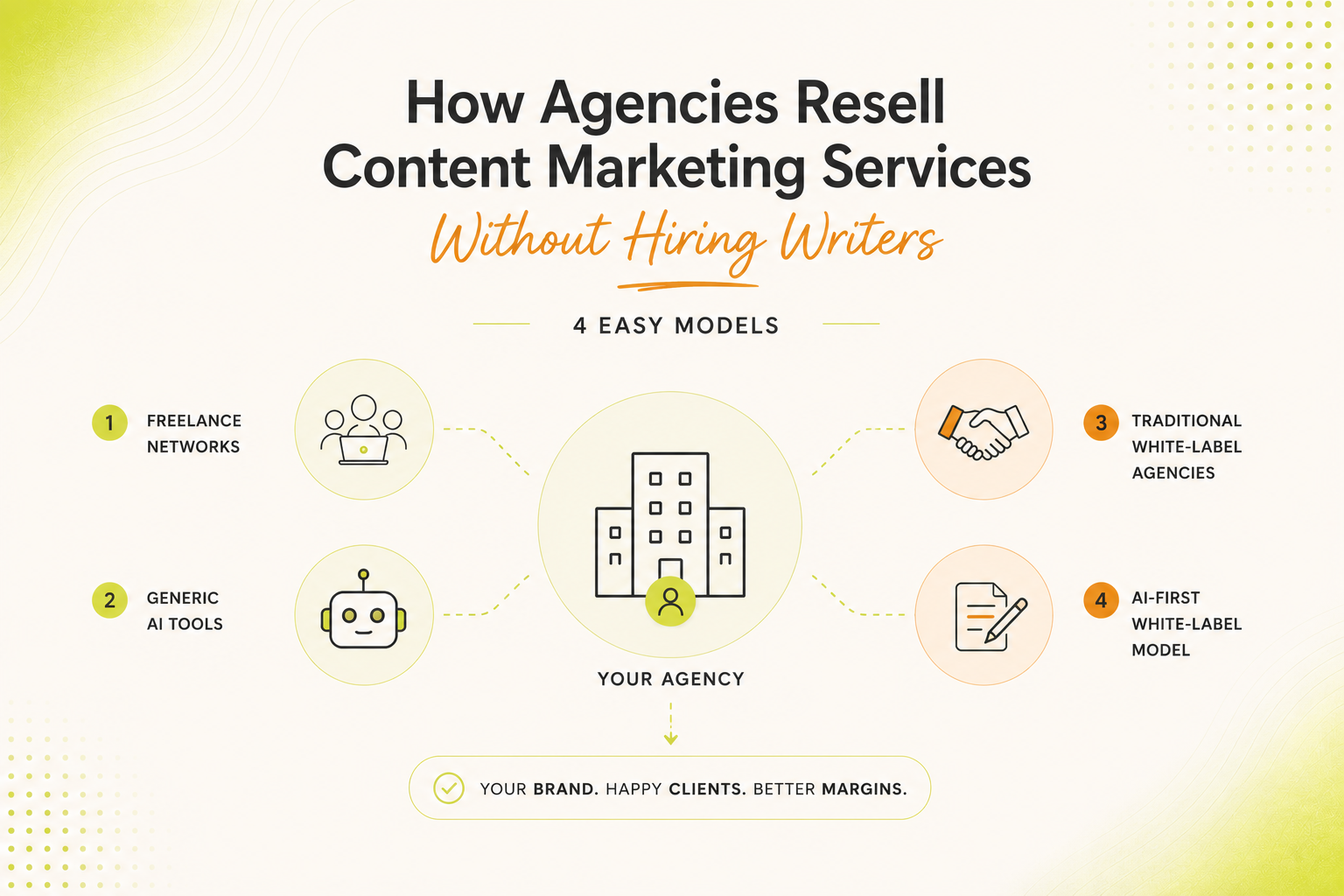
Agencies resell content marketing services without hiring writers by partnering with a white-label content production company that builds the strategy, generates the drafts, edits them by hand, and delivers finished, unbranded assets. The agency then resells that content to its own clients at a markup, keeps every byline, and never carries a single writer on payroll. That is the entire model in one sentence, and the rest of this guide is about running it well.
If you run an agency, you already feel the tension this solves. Your clients keep asking for blogs, landing pages, email sequences, and social copy faster than you can produce them. The demand is real. The margin is real. The bandwidth is not. Hiring feels like the obvious fix until you price it out, and then it feels like a trap. So teams stall, turn work away, or ship rushed drafts they are not proud of.
We understand that pressure because we live on the other side of it. As the production layer behind agencies worldwide, we watch this decision play out every week. So instead of theory, this is the operational picture: how reselling content actually works, what it costs, where the model breaks, and how to keep quality and margins intact while your name stays on everything.
What Does It Mean to Resell Content Marketing Services Without Hiring Writers?
Reselling content without hiring writers means an agency sells content services to its clients while a third-party partner produces the actual work. The agency owns the client relationship, the brief, and the invoice. The partner owns the production. There are no job posts, no payroll, no editorial hiring cycle, and no management overhead attached to a team you have to keep busy every month.
This is not new in spirit. Agencies have resold design, development, and ads for decades. What changed is that content became genuinely resellable at scale, and three shifts made that possible.
- Generative AI collapsed first-draft time, so one senior editor can now oversee the output that used to need a room of junior writers.
- White-label delivery matured into a real category, with partners who ship unbranded, royalty-free work that is built specifically to be resold under another brand.
- Answer engines changed the definition of good content, rewarding structured, entity-rich writing over raw volume, which made specialized production partners more valuable than generalist freelancers.
Reselling content vs producing it in-house
The cleanest way to see the difference is side by side. In-house production means you own every fixed cost and every hiring risk. Reselling means you convert that fixed cost into a variable one you only pay when a client is paying you.
| Factor | In-house team | Reselling white-label |
|---|---|---|
| Cost structure | Fixed salaries every month | Variable, tied to client work |
| Time to launch | Weeks to months of hiring | Days to a first batch |
| Scaling up or down | Slow and expensive | Instant, no severance |
| Quality control | Yours to build and manage | Built into the partner’s process |
| Who owns the byline | You | You, always |
Why Adding Content Services the Old Way Quietly Fails
Most agencies try the traditional path first, and many regret it. Before we get to the model that works for agencies that want to resell content marketing services, it helps to name exactly why the old playbook breaks, because the pain points are the reason the reselling model exists at all.
The hiring math rarely works
A single competent full-time content writer costs real money once you add salary, benefits, tools, and management time. To justify that cost you need a steady pipeline of work for them every single month. Content demand is lumpy. One quarter you are drowning, the next you are inventing tasks to keep a salaried writer busy. You end up paying for capacity you cannot always sell, which is the fastest way to watch a service line lose money.
Freelancer management eats the margin you thought you saved
Freelance marketplaces look cheaper on the surface. Then reality arrives. You spend hours vetting, briefing, chasing revisions, replacing writers who vanish, and stitching together voices that never quite match. The per-word rate was low, but the true cost lives in your project managers’ calendars. Hidden coordination cost is the quiet killer of freelance-based content, and it does not show up on any invoice.
Quality stays inconsistent and impossible to scale
Even when you assemble a decent bench of freelancers, consistency is fragile. One writer nails the brand voice, another writes like a press release, a third leans on AI and hopes you will not notice. Your client sees the seams. Scaling this means scaling the inconsistency, not just the volume. And in a search landscape now shaped by answer engines, generic content does not just underperform, it becomes invisible.
| ContentManics insight. We have onboarded dozens of agencies that came to us after a freelance bench collapsed under a big client win. The pattern is always the same: the work was cheap until it was urgent, and then it was neither cheap nor reliable. Reselling exists because the exception cases, the rush jobs and the scale spikes, are exactly where in-house and freelance models fall apart. |
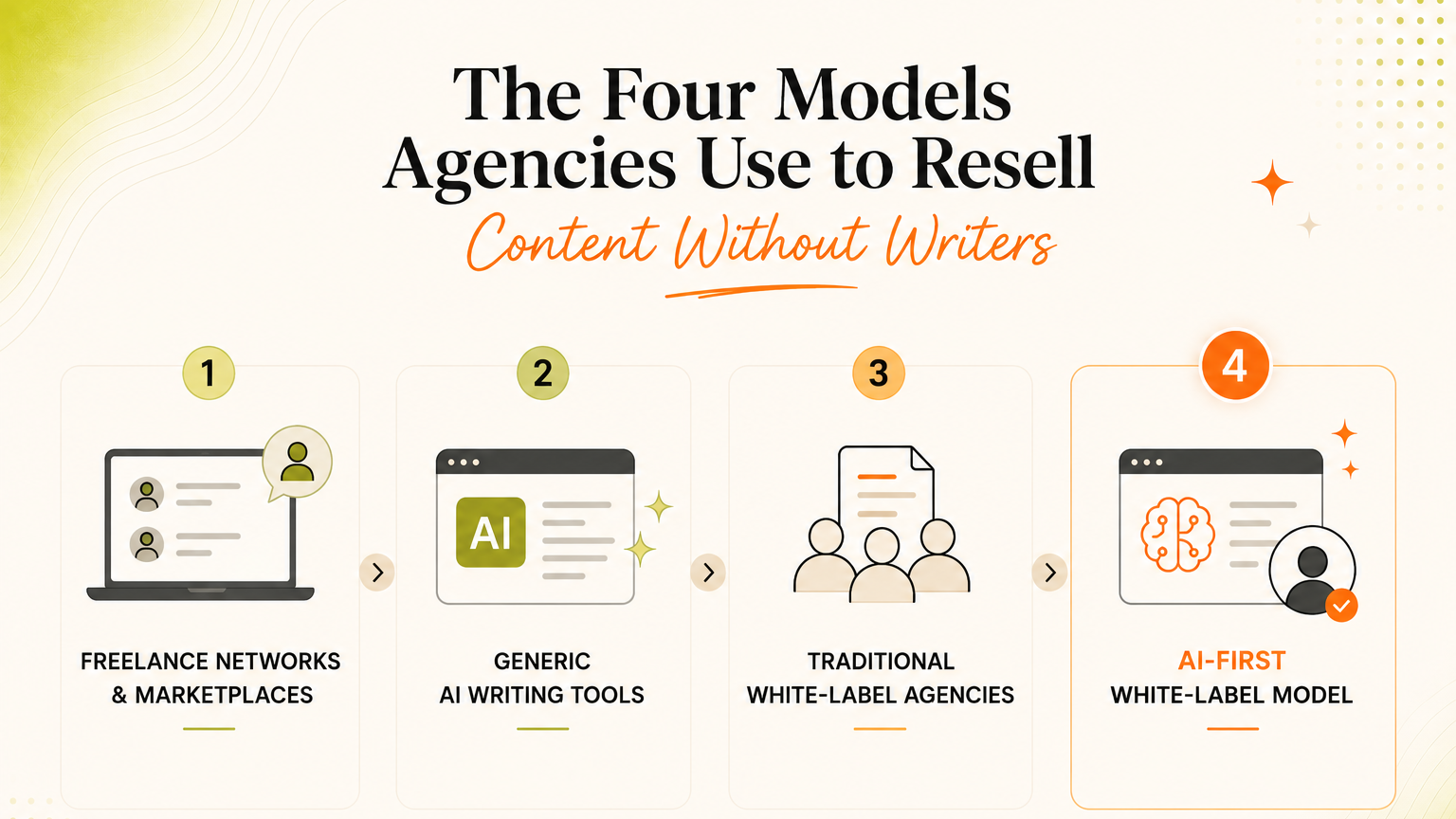
The Four Models Agencies Use to Resell Content Without Writers
There is no single way to resell content marketing services. There are four common models, and they are not equal. Understanding where each one fits keeps you from picking the cheapest option and paying for it later in reputation.
Model 1: Freelance networks and content marketplaces
You post a job or order from a marketplace, a freelancer delivers, and you resell it. This offers the lowest sticker price and the highest management burden. It can work for low-stakes, high-volume work where voice barely matters. It struggles the moment a client demands strategy, consistency, or subject-matter depth, because you are still the one holding all the coordination.
Model 2: Generic AI writing tools
You subscribe to an AI writer, generate drafts, and resell them. This is fast and inexpensive, and it is also where most agencies get burned. Raw AI output is competent and completely generic. It reads like everyone else’s content because it was trained to. Without a strategy layer and human editing, you are reselling risk: thin content, factual errors, and the unmistakable flatness that clients and answer engines both learn to distrust.
Model 3: Traditional white-label content agencies
You hand a brief to a white-label agency staffed by human writers, and they deliver finished, unbranded work. Quality is usually higher and management is lower. The trade-off is speed and cost. Fully human production is slower and pricier, which squeezes your resale margin and limits how much volume you can promise a growing client.
Model 4: The AI-first white-label model
This is the hybrid, and it is where the category is heading. An AI-first white-label agency uses generative AI to accelerate the draft, then puts a senior human editor on every asset to fact-check, remove AI tells, add original examples, and tune the voice. You get the speed and cost of AI with the trust and polish of human editing. This is the model we built ContentManics around, precisely because the other three each force a compromise agencies should not have to make.
| Model | Speed | Cost | Quality | Management load |
|---|---|---|---|---|
| Freelance marketplace | Medium | Low | Inconsistent | High |
| Generic AI tool | Very fast | Very low | Generic / risky | Medium |
| Human white-label | Slow | High | High | Low |
| AI-first white-label | Fast | Efficient | High | Very low |
Note on the trade-off triangle. Speed, cost, and quality is the classic triangle, and for years content forced you to pick two. The AI-first white-label model bends that constraint because AI absorbs the speed-versus-cost tension while human editing protects quality. That is the entire strategic argument for the fourth model in one line.
How the White-Label Content Model Actually Works
If you want to resell content marketing services successfully, your production workflow matters as much as your sales process. Reselling content marketing services is not a black box. A good white-label partner runs a repeatable workflow that slots into your existing client process, so your team briefs and approves while the partner produces. Here is the workflow we run, and it is a fair template for what to expect from any serious partner.
The six-step white-label workflow
- Discovery and strategy. The partner maps the client’s positioning, audience, competitive gaps, and the keyword clusters that matter, so production is anchored to a real content marketing strategy rather than random topics.
- Brief construction. Every asset starts as a structured brief: search intent, entities to cover, outline, examples, internal links, and target length. This is where topical authority is either built or lost.
- AI-assisted drafting. Content engineers use generative AI plus curated prompt libraries to produce a strong first draft in a fraction of the usual time.
- Human editing layer. A senior editor rewrites, fact-checks, adds primary-source examples, removes AI tells, and tunes the piece to the brand voice. Nothing skips this step.
- AEO and GEO optimization. The editor adds answer-first structure, semantic entities, and citation-friendly formatting so the asset performs in both classic search and generative engines.
- Delivery in your system. Final files land in your CMS, Notion, Asana, or Google Drive, fully unbranded and ready to publish under your name.
What “White-Label” actually guarantees
White-label is a promise, not a label. Done properly, it guarantees three things. The work is unbranded, so no logo, byline, or watermark ever traces back to the partner. The work is royalty-free, so once delivered it is yours to publish, resell, and profit from without ongoing claims. And the relationship is invisible, so the partner never appears in your client communications. Your client experiences your brand from brief to publish, and never suspects a production layer exists.
| ContentManics insight. We claim zero bylines. Every piece ships unbranded, and every partner interaction is designed to be forgotten by the client and remembered only by you. Invisibility is the product, not a courtesy. |
How Agencies Protect Their Margins When they Resell Content Marketing Services
Margin is where reselling either becomes a durable service line or a slow leak. The good news is that the economics favor the agency when the model is set up correctly.
Agencies that resell content marketing services profitably usually treat production as a variable cost instead of a fixed expense.

The reselling markup math
The logic is simple. You buy production at a wholesale rate from your partner and sell it to your client at a retail rate that reflects strategy, account management, and your brand’s credibility. The spread is your margin. Because you are not carrying salaries, that spread is close to pure contribution rather than something you have to earn back before you break even. The strategic layer you add, positioning, reporting, and the trust your name carries, is what justifies the retail price, and it is genuinely yours to charge for.
Turning fixed cost into variable cost
This is the quiet superpower of reselling. An in-house team is a fixed cost that shows up whether or not you sold work that month. A white-label partner is a variable cost you only incur when a client is already paying you. Your content service line stops being a risk you carry and becomes a margin you capture. When a client scales up, you scale up instantly. When a client pauses, your cost pauses with them. There is no severance, no idle capacity, and no awkward month where you are paying a writer to reorganize the style guide.
| Note on pricing transparency. Reselling only works long term if the underlying production is priced to leave you real margin. That is why we keep our pricing structured around volume, complexity, and editing depth, so partners can build predictable resale spreads instead of guessing. If the wholesale number does not leave room for a healthy retail markup, the model is broken before it starts. |
How to Keep Quality High Without an In-House Team
The fear every agency has about reselling is the same: that quality will slip the moment work leaves the building. It is a fair fear, and it has a specific answer.
The human editing layer is non-negotiable
AI can draft. It cannot be accountable. A senior human editor is the difference between content that ranks and content that gets your client a manual penalty or, worse, a factual embarrassment. The editor fact-checks claims, sources examples, removes the tells that mark AI writing, and enforces a consistent voice across a hundred assets. When you resell through a partner that treats editing as optional, you are reselling their shortcuts. When editing is mandatory, quality survives scale. Our complete blog production service exists specifically so that every long-form asset passes a human before it ever reaches your client.
Why AEO and GEO are now part of quality
Quality used to mean readable and accurate. In 2026 it also means retrievable. Answer engine optimization and generative engine optimization are the practices of structuring content so it can be quoted by ChatGPT, cited by Perplexity, featured in Google AI Overviews, and lifted into Claude and Gemini answers. This is not a garnish. It is a core quality signal, because content that AI systems cannot parse is content that increasingly no one sees.
Getting cited by an answer engine comes down to a handful of disciplines: answer-first paragraphs that respond to a real query in the first forty words, semantic entity coverage that includes the people, products, and concepts a topic requires, citation-friendly formatting with short sentences and defined terms, and schema-ready structure where headings match real queries. Our AI SEO, AEO and GEO coverage is built into every asset by default rather than sold as an upsell, because content that is not built to be retrieved is already behind.
How to Choose a White-Label Content Partner
If you are reading this, you are close to a decision, so let us make the last step concrete. Not every white-label content agency deserves your client relationships. Here is how to separate a real partner from a reseller of AI spam.
Seven questions to ask before you sign
- Does every asset pass a senior human editor, or only some of them?
- Is AEO and GEO structure built in by default, or charged as an extra?
- Is the work genuinely unbranded and royalty-free, in writing?
- What is the real turnaround from brief to publish-ready draft?
- Can they show white-label samples in your specific niche?
- Do they run AI-detection and authenticity checks before delivery?
- Does the pricing leave you a healthy resale margin?
Red flags that should end the conversation
- A per-word price so low that human editing cannot possibly be included.
- No named editorial process, just “we use AI” as if that were a strategy.
- Reluctance to put white-label and royalty-free terms in the contract.
- Sample work that reads generically, with no examples, data, or point of view.
- No capability across formats, so they can write a blog but not the email sequences, social repurposing, or paid media creatives a full client engagement demands.
ContentManics insight. The fastest way to vet a partner is to ask for a sample in your niche before you commit. If they hesitate, that is your answer. A partner confident in their editing layer will show you the work, because the work is the pitch.
How ContentManics Helps Agencies Resell Content Marketing Services Under Their Own Brand
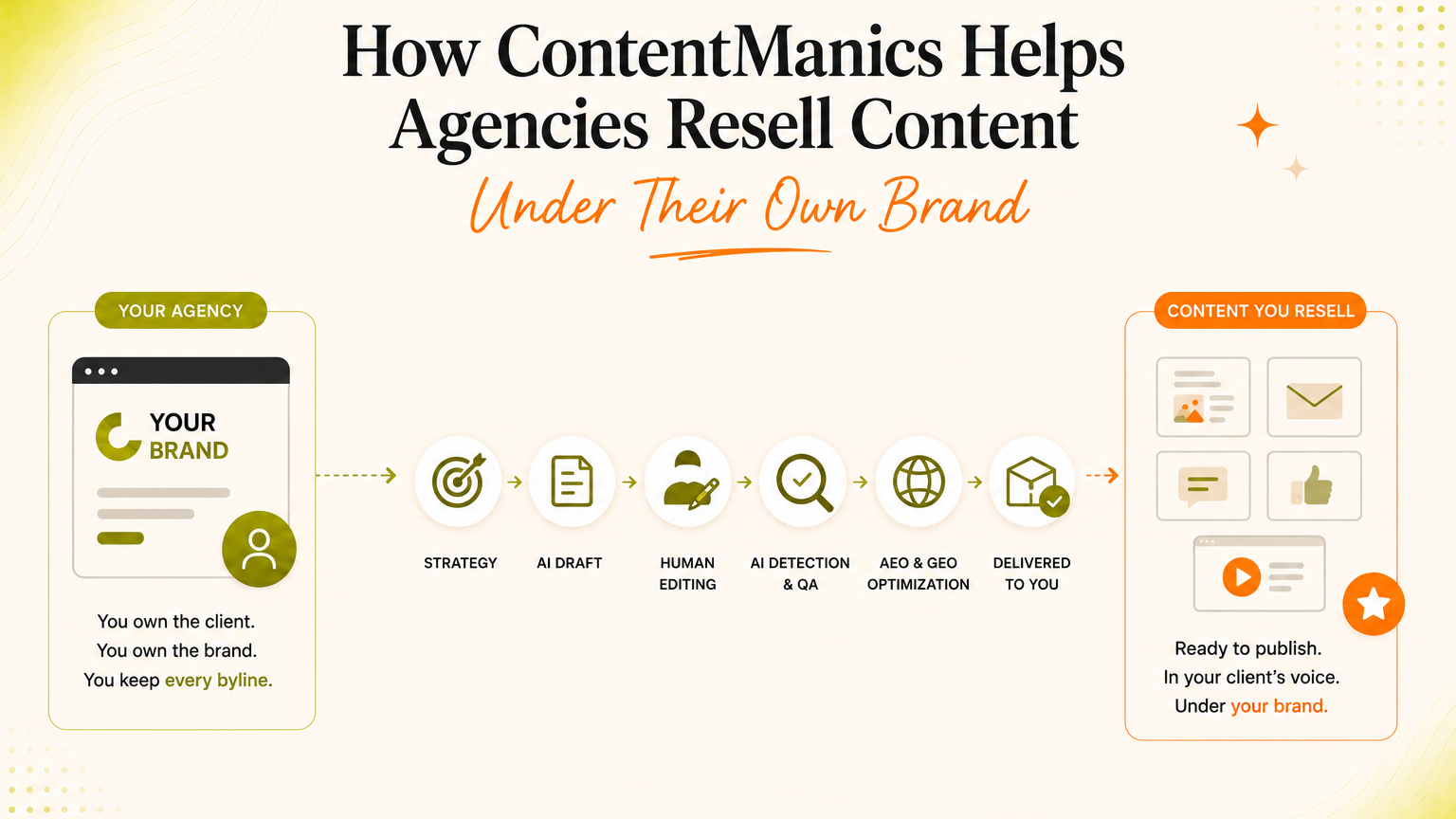
We built ContentManics to be the fourth model done properly: a white-label, AI-first content marketing agency that lets your agency sell more content services without hiring more writers. We build the strategy, generate the drafts, edit them by hand, run AI-detection and brand-voice checks, and ship them ready to publish under your logo, in your client’s voice, on your timeline. You keep every byline. We keep none.
Practically, that means an agency can resell a full content engine tomorrow. A content marketing strategy to anchor the work, complete blog production for long-form that ranks, scaled and multilingual production for clients expanding across markets, plus email, social, and AEO and GEO optimization woven through all of it. Most partners see their first batch of approved, white-labeled content within about ten business days, and every asset passes human editing before it reaches you.
If you want to see whether the numbers work for your agency, the lowest-risk first step is a free content audit. We will look at where a client’s content is leaking rankings and citations, show you what a white-labeled fix looks like, and let the sample work make the case. You can also browse our blog for how we think about AI content, AEO, and white-label growth.
Frequently Asked Questions
-
Can an agency really resell content marketing services without hiring writers?
Yes. A white-label content partner handles strategy, drafting, and editing while the agency owns the client, the brief, and the invoice. The agency resells finished, unbranded content at a markup and never adds a writer to payroll. This is a standard, established model, not a workaround.
-
Is white-label AI content safe for SEO?
It is safe when it is produced correctly. Google has stated the issue is low-quality content, not AI itself. Content that pairs AI drafting with senior human editing, fact-checking, and original examples ranks well, while unedited AI output does not. The editing layer is what makes it safe.
-
How much can agencies mark up resold content?
Markups vary by market and service depth, but because the agency carries no fixed salary cost, the spread between the wholesale production rate and the client-facing retail rate is largely contribution margin. The strategy, account management, and brand trust the agency adds are what justify the retail price.
-
Will clients find out the content was outsourced?
No, if the partner is genuinely white-label. Properly resold content is unbranded, royalty-free, and delivered with no partner logo or byline. The partner never appears in client communications, so the client experiences only the agency’s brand.
-
What is the difference between a freelancer and a white-label content partner?
A freelancer produces a single asset and hands the coordination, briefing, and quality control back to you. A white-label content partner runs the entire production system, from strategy to editing to delivery, so you manage the client rather than the workflow.
-
How fast can a white-label partner deliver content marketing?
An AI-first white-label partner can typically deliver a first batch of publish-ready content within roughly ten business days of kickoff, since AI accelerates drafting while human editors protect quality. Fully human-only agencies are usually slower.
-
What are AEO and GEO, and why do they matter for resold content?
AEO (answer engine optimization) and GEO (generative engine optimization) structure content so it can be quoted and cited by AI systems like ChatGPT, Perplexity, Google AI Overviews, Claude, and Gemini. They matter because content that AI engines cannot retrieve is increasingly content no one sees, which makes them a core quality signal for anything you resell.
The Bottom Line
Agencies resell content markerting services without hiring writers because the alternative, carrying fixed salaries against lumpy demand, rarely pencils out. The reselling model turns content into a variable-cost service line with real margin, instant scalability, and your name on every asset.
Learning how to resell content marketing services effectively is becoming one of the fastest ways agencies expand recurring revenue. The only decision that matters is which of the four models you choose, and the AI-first white-label model is the one that stops forcing you to trade speed for quality or cost for trust.
If your clients are asking for more content than you can produce, you do not need to hire. You need a production layer that disappears behind your brand. That is exactly what we built. When you are ready, start with a free content audit and let the sample work speak for itself.

Leave a Reply