
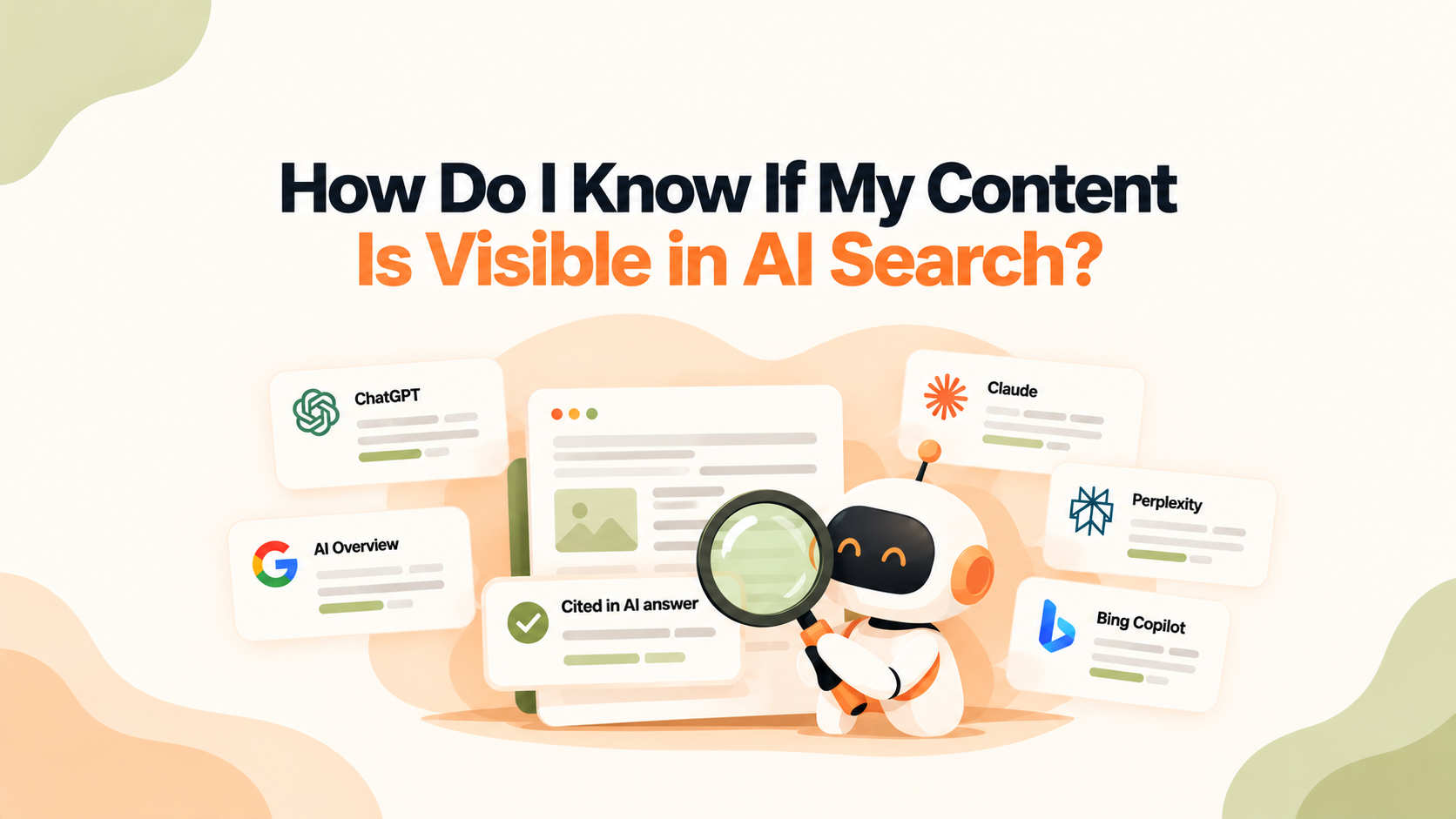
You published a great article. It ranks on Google. But is it showing up when someone asks an AI chatbot about your topic?
That is the new question.
AI search is different from traditional search. Instead of just listing links, AI tools read your content, summarize it, and sometimes cite it directly in their answers. If your content is not visible to these systems, you are missing a growing slice of traffic and authority.
Here is how to tell if your content is visible in AI search, and what to do if it is not is not. If you already rank on Google but never see citations, start with why high-ranking pages still go uncited by ChatGPT.
What “visible in AI search” actually means
When we say your content is “visible in AI search,” we mean two things:
- AI systems can access and read your pages without being blocked.
- AI systems use your content when generating answers, either by citing it explicitly or by learning from it during training.
Visibility does not always mean a clickable link. Sometimes it means your ideas, data, or examples show up in AI-generated summaries even if your URL is not displayed.
Quick ways to check if your content is showing up in AI answers
Start with simple, manual tests.
1. Ask AI tools directly about your topic
Pick a few representative questions your content answers. Then ask them in:
- ChatGPT
- Google AI Overviews (via Google Search)
- Perplexity
- Bing Chat (Copilot)
- Claude
Example: if your article is “How to choose a running shoe for flat feet,” ask:
- “What should someone with flat feet look for in running shoes?”
- “Best running shoes for flat feet 2026”
Look for:
- Mentions of your brand or site name
- Specific facts, numbers, or examples that match your content
- Direct citations or links to your URL
If you see your content reflected in multiple AI tools, that is a good sign.
2. Search for your URL or brand in AI chat contexts
Some AI tools let you reference specific sites. Try prompts like:
- “What does [yourdomain.com] say about [topic]?”
- “Summarize [yourdomain.com/article-slug]”
- “Has [your brand] published anything on [topic]?”
If the AI can summarize your page or quote details, your content is at least accessible and indexed in some form.
3. Use AI-focused search and discovery tools
A few tools are built to show how content appears in AI-driven results:
- Perplexity often shows sources under each answer. Search your topic and see if your URL appears.
- Google AI Overviews sometimes display cited sources. Check the “sources” section under AI-generated summaries.
- Search console and analytics will not tell you “AI traffic” directly yet, but you can look for:
- Spikes in referral traffic from AI platforms (if they start sending clicks)
- Increases in branded searches after your content is published
Over time, more tools will expose AI-specific performance data. For now, manual checks plus analytics trends are your best bet.
Technical checks: are you accidentally blocking AI?
Even great content can be invisible if crawlers cannot reach it.
1. Review your robots.txt
Check yourdomain.com/robots.txt. Look for rules that might block AI-related crawlers, such as:
GPTBotCCBotGoogle-ExtendedBingbot(for Bing/Copilot)- Other AI or aggregator bots mentioned in your server logs
If you see lines like:
textUser-agent: GPTBot
Disallow: /
then you are explicitly telling that AI system not to crawl your site. Remove or adjust those rules if you want your content to be visible in AI search.
2. Check for noindex or restrictive headers
Make sure important pages are not marked with:
<meta name="robots" content="noindex">X-Robots-Tag: noindex- Overly restrictive
Content-Security-Policyor authentication walls that prevent public access
AI systems generally only use publicly accessible content. If a page requires login or is blocked by paywalls without a crawler-friendly version, it will not be visible.
3. Confirm your pages are indexed by major search engines
AI models often rely on indexed web content. Use:
- Google Search Console → URL Inspection tool
site:yourdomain.com/your-article-slugin Google
If Google cannot index your page, many AI systems will struggle to find and use it.
Content signals that improve AI visibility
Beyond technical access, certain content traits make it more likely that AI systems will notice and use your pages.
1. Clear structure and headings
AI systems parse content better when it is well organized. Use:
- Descriptive H1 and H2 headings
- Logical hierarchy (H1 → H2 → H3)
- Short paragraphs and bullet lists
This helps AI tools extract key points and match them to user questions.
2. Direct answers to common questions
AI search thrives on question-and-answer patterns. For each major topic:
- Include an explicit question as a heading (for example, “How do I know if my content is visible in AI search?”)
- Follow with a concise, direct answer in the first 1–2 paragraphs
- Then expand with details, examples, and steps
This structure aligns with how AI models generate responses.
3. Original data, examples, and unique insights
Generic content blends together. AI systems are more likely to cite:
- Proprietary data or research
- Unique frameworks or step-by-step processes
- Specific case studies and real-world examples
If your article repeats what 50 other sites say, AI may learn from the cluster but not attribute anything to you. If you add something new, your chances of being referenced go up.
4. Clear attribution and branding
Make it easy for AI to associate content with your brand:
- Use your brand name consistently
- Include author bylines and bios
- Add structured data (schema) for Article, Organization, and Person where relevant
This helps AI systems understand who published the content and when.
How to interpret what you find
After running the checks above, you will land in one of these situations.
Your content appears in AI answers with citations
This is the best case. Your pages are:
- Crawlable
- Indexed
- Seen as authoritative enough to cite
Focus on:
- Maintaining content quality and freshness
- Expanding into related questions that AI users ask
- Monitoring for any changes in how your content is represented
Your content influences answers but is not cited
You might see your ideas, numbers, or frameworks reflected without a link. That still means your content is being used, but attribution is weak.
To improve this:
- Strengthen branding within the content (“According to [Brand] research…”)
- Add clear, unique data points that are easy to attribute
- Build external links and mentions so AI systems associate those facts with your domain
Your content does not appear at all
If AI tools cannot find or use your content, revisit the basics:
- Fix any robots.txt or noindex blocks
- Ensure pages are indexed by major search engines
- Improve structure, clarity, and uniqueness of the content
- Promote the content so it gains links and mentions
Then retest after a few weeks.
A simple checklist you can use today
Run through this list for your most important pages.
- I searched my topic in at least two AI tools and checked for my URL or brand.
- I asked AI tools direct questions about my content and reviewed the answers.
- I confirmed my pages are indexed in Google (Search Console or
site:query). - I reviewed
robots.txtand removed blocks for AI crawlers I want to allow. - I removed
noindextags from pages I want visible in AI search. - My content has clear headings, short paragraphs, and direct answers to key questions.
- I included original data, examples, or unique insights not found on every other site.
- My brand and authors are clearly identified on the page.
If most of these are true, your content is in a good position to be visible in AI search.
Final thought
AI search is not a separate universe. It builds on the same foundations as traditional search: accessible, high-quality, well-structured content that people find useful.
The difference is the interface. Instead of a list of links, users see synthesized answers. Your goal is to make sure your content is part of that synthesis.
Check your visibility now. Fix any access issues. Sharpen your content. Then keep watching how AI tools represent your work over time.


Leave a Reply