
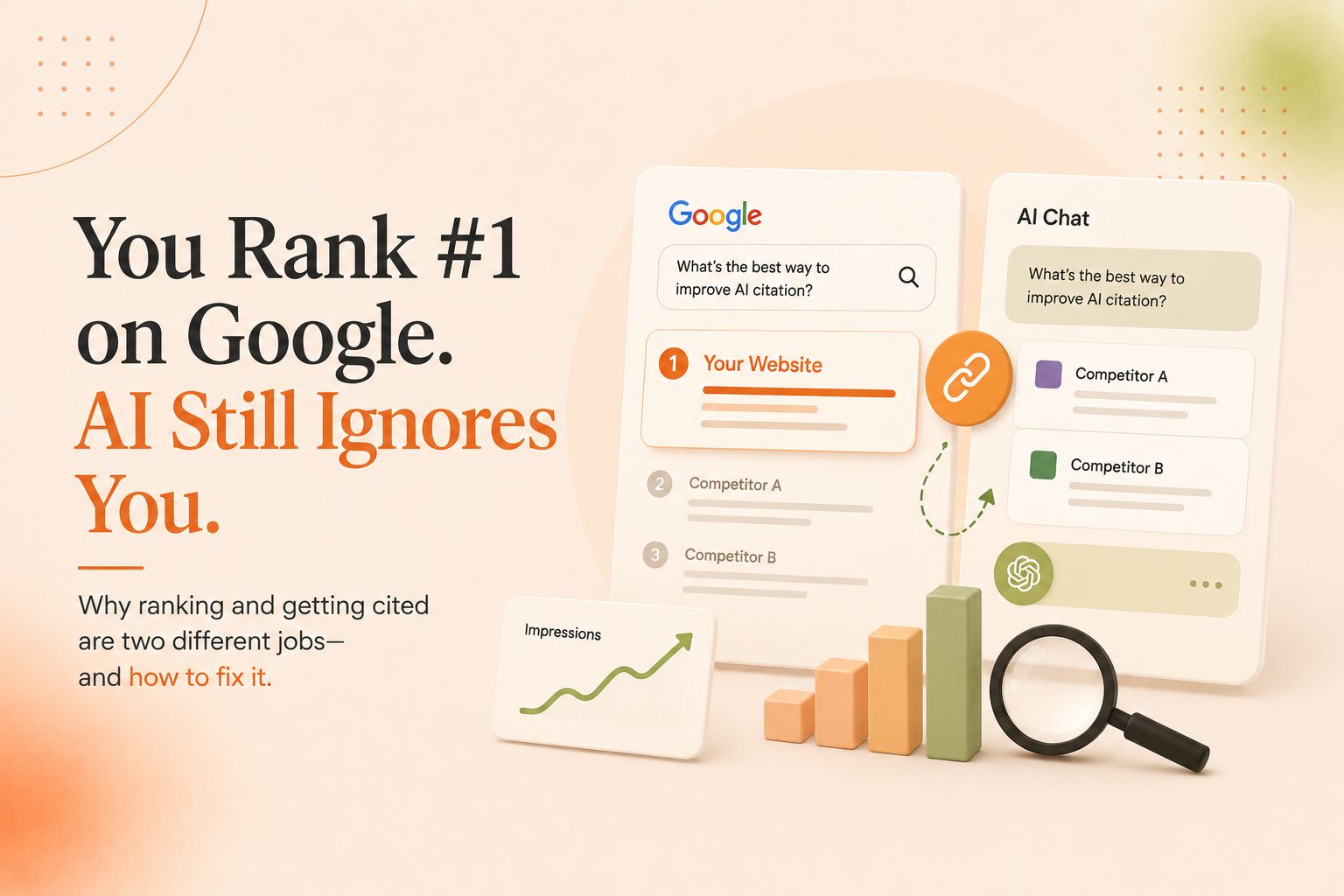
You checked Search Console this morning and it looked healthy. Impressions are up. That page has been sitting at position one for months. Then, out of curiosity, you typed the exact same question into ChatGPT
And watched it recommend two competitors you outrank on Google, without mentioning you at all. If that stung more than it should have, you are not overreacting.
You built something that works, by every metric you were taught to trust, and a different system is quietly ignoring it.
Quick answer: Ranking and getting cited are two different jobs, scored by two different systems. Google ranks pages for people who will click a blue link, rewarding backlinks, engagement, and topical authority built over time. AI engines like ChatGPT, Perplexity, and Google’s own AI Overviews extract specific, quotable facts to assemble an answer nobody will click through to read the source of. A page can dominate one job and fail the other completely, because the two were never actually measuring the same thing.
Key Takeaways
- Ranking measures authority and click-worthiness. Citation measures extractability. A page can win one test and fail the other for structural reasons that have nothing to do with quality.
- Independent citation analyses have consistently found that only a small share of the pages AI engines cite also rank in Google’s top ten for the same query — the overlap is much smaller than most marketers assume.
- Each AI engine sources differently. ChatGPT leans heavily on real-time web and Bing signals; Perplexity and Google AI Overviews lean more on Google’s own index. “I rank on Google” is a stronger hand with some engines than others.
- The fix is not “more SEO.” It is restructuring how a claim is presented on the page, plus building citation signals beyond the page itself.
- Fixing a page for AI citation does not require sacrificing its Google ranking. You are adding a layer, not replacing one.
Ranking and Getting Cited Are Two Different Jobs
Google’s algorithm and an AI engine’s citation model are solving different problems, which is exactly why a page can win one and lose the other. Google is built around the click. It rewards a page that signals authority, matches intent, loads fast, and keeps a visitor engaged, because the entire business model depends on someone leaving Google to visit your site. An AI engine has no such incentive. It reads a page, pulls out the specific claims that answer the user’s question, and assembles those claims into a response the user never has to leave the chat window to get. The user doesn’t click. The AI doesn’t need your whole page to be excellent. It needs three or four sentences on your page to be extractable.
Think about it the way a courtroom treats testimony. A witness can be well-respected in their field, credentialed, likeable, and generally trustworthy — the equivalent of strong domain authority. But if, when actually asked the question, their answer is vague, hedged, or buried in a long story, the jury can’t use it as a clean fact for the record. A different witness who states one precise, verifiable detail gets quoted in the verdict, even if their overall reputation is thinner. AI engines are the jury. They are not grading your reputation. They are looking for the one sentence they can safely put in quotes.
This is also why the overlap between “ranks well” and “gets cited” is smaller than most people expect. Independent citation studies tracking thousands of prompts across ChatGPT, Perplexity, and Copilot have repeatedly found that only a modest fraction of AI-cited sources also appear in Google’s top ten for the same query. Some of the most-cited pages in AI answers rank nowhere in traditional search at all. That is not a bug in either system. It is proof that they are scoring different things.
Five Structural Reasons Your #1 Page Still Isn’t Cited
Most citation gaps trace back to one of five fixable structural issues, not to the overall quality or authority of the page. Here is where we usually find the problem when a client brings us a page that ranks well but gets ignored by AI answers.
1. The Answer Is Buried, Not Stated
A page built for Google can afford a long, scene-setting introduction before it gets to the point, because a human reader who clicked is already invested. An AI engine has no such patience. If the direct answer to the query isn’t stated plainly within the first few hundred words, in a sentence that could stand alone as a quote, the model moves on to a page that gets there faster.
2. The Page Reads as One Long Argument, Not a Set of Discrete Claims
Google rewards comprehensive, well-linked pages that build a case across three thousand words. AI engines extract at the sentence and paragraph level, not the whole-page level. A page that buries its best insight inside an unbroken wall of text loses to a page that states the same insight in a clearly labeled section, even a shorter and less authoritative one. Structure doesn’t change what the content means. It changes whether the retrieval layer can find it.
3. Claims Are Vague Instead of Citable
“Many businesses see improved results” is not a claim an AI engine can safely attribute to you. “Businesses that restructured their top pages saw citation rates increase within six weeks” is. A number, a date, a named source, or a concrete definition is easy to extract and attribute. A vague observation is not, no matter how true it is.
4. The Page Has No Life Outside Itself
Google can rank a page almost entirely on its own merits plus backlinks. AI engines weigh something broader: whether your brand shows up consistently across the web the model has ingested — other sites mentioning you, structured listings, documentation, forum answers, comparison content. A single excellent page sitting on an otherwise quiet domain reads as a lower-confidence source than a page backed by a visible footprint elsewhere.
5. You’re Optimizing for the Wrong Engine
This is the one almost nobody accounts for. Perplexity and Google AI Overviews lean heavily on Google’s own index, so strong SEO carries over reasonably well. ChatGPT’s citation behavior is more independent, weighted toward its own crawl, Bing signals, and brand mentions across the open web — which means a page can be genuinely excellent by Google’s standards and still be functionally invisible to ChatGPT specifically, because ChatGPT was never grading on that curve to begin with. “AI visibility” isn’t one target. It’s several, and they don’t all move together.
What Actually Fixes It (Not Just What Causes It)
Closing the gap means restructuring how existing claims are presented and building brand signals beyond the page, not writing more content or chasing new keywords. This is the part most guides stop short of, because most of what’s published on this topic is written by people diagnosing the problem from the outside, not people who’ve spent a production cycle actually rewriting pages and watching what changes.
Here’s the order that gets results fastest, based on what we run for clients:
- Rewrite the opening for extraction, not seduction. The first 100–150 words should state the direct answer plainly, the way you’d answer if someone asked you the question out loud at a conference and you had one sentence to do it. Save the narrative framing for after the answer, not before it.
- Break the page into citable chunks. Restructure long sections into labeled sub-answers of roughly 150–300 words, each capable of standing alone as a quote. This usually means adding more subheadings than feels natural at first — that discomfort is a sign you were writing for a reader’s patience, not a model’s extraction pass.
- Replace vague statements with specific, sourced ones. Every claim that currently reads as an opinion should either get a number, a named source, or a concrete example attached to it, or get cut.
- Build brand signals off the page. Citations compound faster when the model has seen your brand elsewhere — genuine mentions, structured directory listings, comparison content, documentation. A single perfect page rarely outperforms a page backed by a real footprint.
- Check engine by engine, not as one bucket. Run the actual target query through ChatGPT, Perplexity, and Google AI Overviews separately. A fix that moves the needle in one may do nothing in another, and you want to know that before you declare victory.
| A ContentManics note.This is exactly why our briefs never separate “SEO” from “AEO and GEO” into two passes. Every brief that leaves our strategy team already specifies the direct-answer opening, the citable chunk structure, and the entity signals a writer needs to hit, before a single word is drafted. Retrofitting a page after the fact works, but it’s slower and less consistent than building it in from the brief. That’s the difference between an audit telling you what’s wrong and a production process that doesn’t produce the problem in the first place. |
Does Fixing This Hurt Your Google Rankings?
No. The changes that improve AI citation — clearer structure, more specific claims, stronger brand signals — generally help Google rankings too, because both systems reward genuinely useful, well-organized content. The two disciplines overlap far more than they conflict. You are not choosing between ranking and being cited. In the rare case where a change is purely engine-specific (like reformatting for a stricter extraction pass), it’s additive, not destructive — you’re not removing anything Google valued, you’re adding a layer the AI engines were missing.
The one habit to avoid: don’t chase citation by padding a page with more content. Citation rewards precision, not length. A page that gets tighter and more specific usually reads better for a human too.
How Many Pages Actually Need This
Not all of them, and probably not all at once. Start with the pages already carrying your organic traffic and rank well — those are your highest-leverage candidates, because you’ve already done the hard part of earning authority; you’re only fixing extractability. Prioritize pages that answer a question a buyer would actually ask an AI assistant directly (“what is,” “how does,” “which is better”), since those are the query types AI engines answer most often without sending the user anywhere. A blog with fifty posts rarely needs fifty rewrites to see a real shift. It usually needs its dozen highest-intent pages restructured properly.
Frequently Asked Questions
Is GEO just a new name for SEO?
No. They overlap heavily but optimize for different outcomes. SEO optimizes for ranking position and clicks. GEO (generative engine optimization) optimizes for the likelihood that an AI system extracts and cites your content directly inside its answer, with no click involved at all.
Will restructuring my content for AI citation make it read worse for human visitors?
Not if it’s done well. The same clarity that helps an AI engine extract a claim — a direct answer up front, clearly labeled sections, specific rather than vague statements — tends to make a page easier for a human to skim too. Poorly done, any optimization can feel mechanical. That’s a production-quality problem, not a GEO problem specifically.
How long does it take to start seeing AI citations after a fix?
It varies by engine and by how often that engine refreshes its index or crawl. Some citation shifts show up within weeks; others take a full crawl-and-index cycle. Track the actual query in each engine manually rather than waiting for a dashboard number, since not every engine offers reliable self-reporting yet.
Do I need separate content for Google and for AI engines?
Almost never. The goal is one well-structured page that serves both, not a duplicate version for each system. Maintaining two versions of every page is a production burden most teams can’t sustain, and it isn’t necessary when the underlying fixes (clear answers, specific claims, strong structure) genuinely help both.
Does this only matter for big brands?
No. Some of the most-cited pages in AI answers come from sites with modest overall authority, because citation rewards extractability and specificity more than raw domain strength. A smaller brand with a precisely structured page can out-cite a larger competitor with a sprawling, vague one.
The Bottom Line
Ranking on Google and getting cited by AI are two different jobs, and treating them as the same task is why so many well-ranked pages are quietly invisible in the tool their buyers now use first. The fix isn’t a new content calendar or a pile of fresh blog posts. It’s going back into the pages that already earned their authority and making their best claims extractable, specific, and backed by a real presence beyond the page itself. That’s a production problem, not a mystery, and it’s one we solve for clients as a standard part of how we brief and build content, not as a separate audit bolted on afterward.
If you want a straight read on where your own top pages actually stand across ChatGPT, Perplexity, and Google AI Overviews, our free content audit is a low-pressure place to start. And if you’re building this in from scratch rather than retrofitting, that’s exactly what our AI SEO, AEO, and GEO coverage is built to do.

Leave a Reply