
You publish content consistently.
You follow best practices.
You even check your rankings.
But traffic is flat. Conversions are stuck. And you have no idea which pieces to fix, which to kill, and which to double down on.
That is where an AI-optimized content audit comes in.
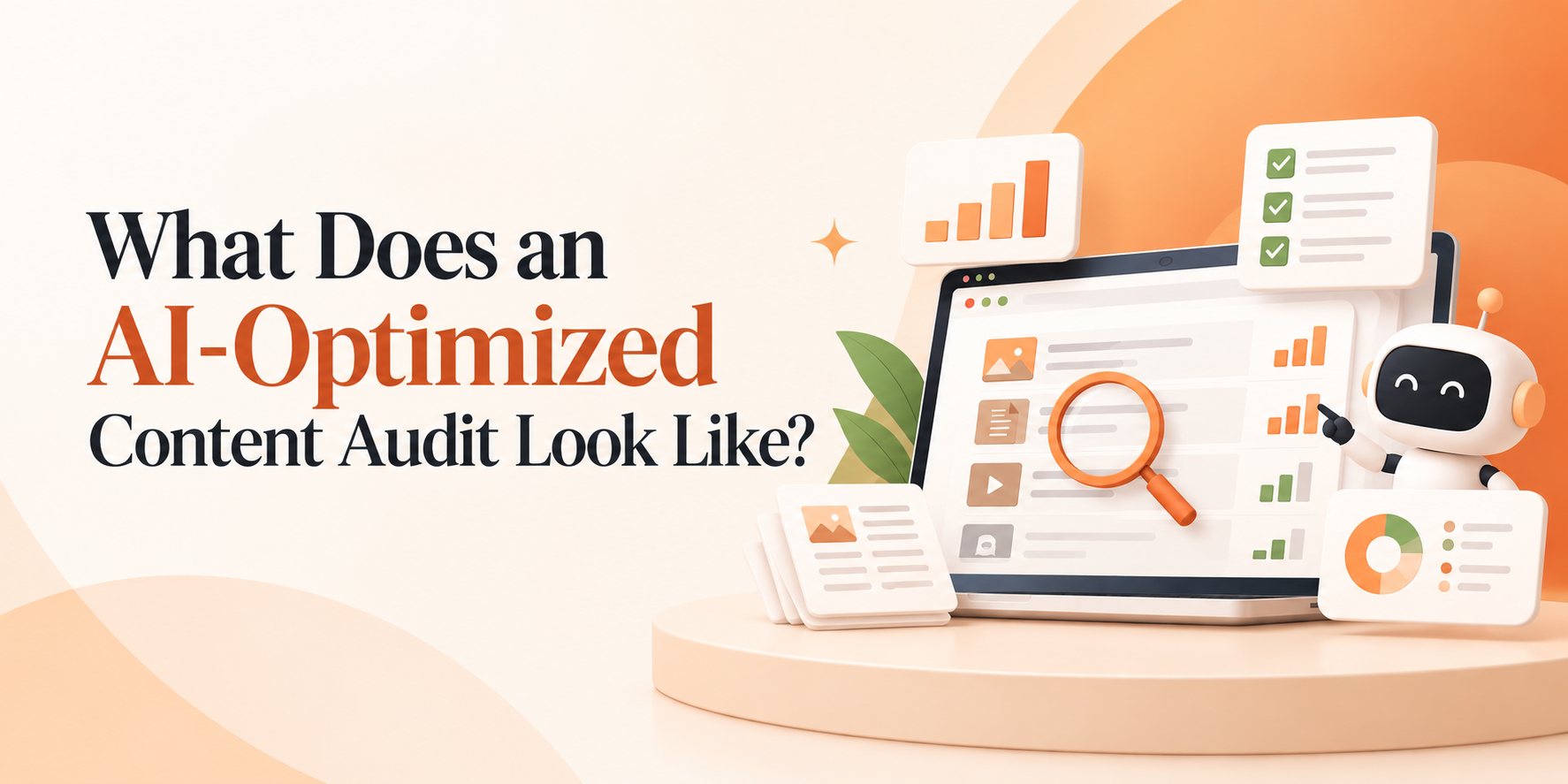
This is not a superficial checklist. It is a systematic, data-driven process that uses AI to surface hidden opportunities, prioritize high-impact fixes, and turn your content library into a growth engine.
In this guide, you will learn exactly what an AI-optimized content audit looks like, why it outperforms manual audits, and how to run one yourself (with or without a dedicated tool).
Let us dive in.
Why Traditional Content Audits Fail
Most content audits follow the same tired script.
- Export all URLs from Google Analytics or Search Console.
- Sort by traffic or rankings.
- Manually review a sample of pages.
- Make a spreadsheet with color-coded status tags.
- Hope your team has time to act on it.
The problem?
This approach is slow. It is subjective. And it rarely scales beyond a few dozen pages.
Worse, it misses the patterns that actually move the needle.
- Which topics are trending but under-covered?
- Which pages have strong backlinks but weak on-page SEO?
- Which content clusters are cannibalizing each other?
- Which updates will compound over time instead of delivering one-off bumps?
Manual audits answer some of these questions. AI-optimized audits answer all of them, at scale.
The Core Components of an AI-Optimized Content Audit
An AI-optimized content audit is built on four pillars.
1. Comprehensive Data Aggregation
AI needs data to work with.
A proper audit pulls in signals from multiple sources.
- Organic performance: impressions, clicks, CTR, average position (Google Search Console).
- Engagement metrics: time on page, bounce rate, scroll depth, conversions (GA4, Hotjar, etc.).
- Backlink profile: referring domains, anchor text, link velocity (Ahrefs, Majestic, or similar).
- On-page signals: word count, heading structure, internal links, image usage, schema markup.
- Competitive context: top-ranking pages, content gaps, SERP features.
Search Console and GA4 do not show whether AI assistants cite your pages, so add a manual spot check with these three ways to test whether your content is visible in AI search.
AI-First content marketing agencies like ContentManics automate this aggregation, so you do not waste hours stitching together CSVs and dashboards.
2. Pattern Recognition and Clustering
This is where AI shines.
Instead of reviewing pages one by one, AI groups your content into meaningful clusters.
- By topic and intent (informational, commercial, transactional).
- By performance tier (top 10 percent, middle 60, bottom 30).
- By content type (guides, listicles, product pages, landing pages).
- By update frequency and freshness.
These clusters reveal where your strengths and weaknesses truly lie.
For example, you might discover that your “how-to” guides drive 70 percent of your organic traffic, but your “best X for Y” posts have 3x more backlinks and higher conversion rates.
That insight alone changes your content roadmap.
3. Actionable Recommendations, Not Just Scores
Many tools spit out a content “score” and call it a day.
That is not helpful.
An AI-optimized audit goes further. It tells you what to do next.
- “Update this post with 2026 data and add a comparison table.”
- “Merge these three thin posts into one definitive guide.”
- “Add internal links from these five high-authority pages.”
- “Rewrite the intro to match search intent more closely.”
- “Add FAQ schema to capture more SERP real estate.”
The best platforms, like ContentManics, generate these recommendations automatically, ranked by estimated impact.
4. Prioritization Framework
You cannot fix everything at once.
AI helps you prioritize by combining multiple signals.
- Traffic potential (search volume, trend direction).
- Difficulty (current ranking, competition strength).
- Effort (estimated time to implement changes).
- Business value (alignment with revenue goals, lead quality).
The output is a clear action queue.
- Quick wins (high impact, low effort).
- Strategic bets (high impact, higher effort).
- Maintenance tasks (low impact, but necessary).
- Candidates for pruning or redirecting.
This framework ensures your team always works on the right thing next.
Step-by-Step: Running Your First AI-Optimized Content Audit
Here is how to execute an AI-powered audit from start to finish.
Step 1: Define Your Goals
Before you touch any tool, clarify what you want.
- Increase organic traffic by 40 percent in six months?
- Improve conversion rate on bottom-of-funnel content?
- Recover from a core update?
- Build topical authority in a new niche?
Your goal determines which metrics matter most and how AI should weight its recommendations.
Step 2: Connect Your Data Sources
Link your analytics, search console, and any SEO platforms you use.
If you use ContentManics, this takes minutes. The platform integrates directly with Google Search Console, GA4, and major backlink databases.
If you are doing this manually, export your data and upload it to your AI tool of choice.
Step 3: Let AI Analyze and Cluster
Run the audit.
The AI will process thousands of data points across your entire content library.
Wait for it to generate clusters, scores, and recommendations.
Do not skip this step. The clustering is where the magic happens.
Step 4: Review the Priority Queue
You will see a ranked list of actions.
Focus on the top 10 to 20 items first.
These are your quick wins and strategic bets.
Look for patterns.
- Are multiple recommendations pointing to the same content gap?
- Do several high-value pages lack internal links?
- Is there a cluster of outdated posts that need a refresh?
Step 5: Execute and Track
Assign tasks to your team.
Set deadlines.
Track progress in your project management tool.
Most importantly, measure results.
- Did rankings improve?
- Did traffic increase?
- Did conversions go up?
Use these results to refine your next audit cycle.
What Makes ContentManics Different
You might be wondering how ContentManics fits into this workflow.
ContentManics is built specifically for AI-optimized content audits.
Here is what sets it apart.
- Unified data layer: No more juggling spreadsheets. All your performance, backlink, and on-page data lives in one place.
- Smart clustering: AI groups your content by topic, intent, and performance, so you see the big picture instantly.
- Action-first recommendations: Instead of vague scores, you get specific, implementable tasks ranked by impact.
- Prioritization engine: The platform tells you what to fix first based on traffic potential, effort, and business value.
- Continuous monitoring: Your audit is not a one-time event. ContentManics tracks changes over time and alerts you to new opportunities.
Think of it as having a senior SEO strategist working 24/7 on your content library.
Common Mistakes to Avoid
Even with AI, audits can go wrong.
Here are the pitfalls to watch for.
Ignoring Search Intent
AI can analyze data, but it cannot read your mind.
Always validate recommendations against actual SERPs.
If the top results are all video-based, a text-only update will not cut it.
Over-Optimizing for Metrics
Do not chase traffic at the expense of relevance.
A page with modest traffic but high conversion value is often more important than a high-traffic top-of-funnel post.
Skipping the Human Review
AI is powerful, but it is not infallible.
Have an experienced editor or strategist review the recommendations before your team starts implementing.
Treating It as a One-Off
An AI-optimized audit is not a project. It is a process.
Schedule quarterly audits to keep your content fresh and aligned with algorithm changes.
The Bottom Line
An AI-optimized content audit transforms your content strategy from reactive to proactive.
Instead of guessing which pages to update, you know exactly where to focus.
Instead of wasting time on low-impact tweaks, you work on changes that compound.
And instead of letting your content library become a graveyard of outdated posts, you turn it into a living, breathing growth engine.
AI-First content marketing agencies like ContentManics make this accessible, even for small teams.
But the principles apply regardless of your stack.
Aggregate data. Cluster intelligently. Generate actionable recommendations. Prioritize ruthlessly. Execute and measure.
Do this consistently, and your content will not just rank.
It will convert.
It will compound.
And it will become your most valuable marketing asset.
Next Steps
Ready to run your first AI-optimized content audit?
Start by defining your goal.
Then connect your data sources.
If you want to accelerate the process, explore platforms like ContentManics that automate the heavy lifting. Start by defining your goal. Then connect your data sources. Prefer a human-reviewed first pass? Request a free content audit that grades your pages across SEO, AEO and GEO.
Whatever path you choose, take action today.
Your future traffic (and your future self) will thank you.

Leave a Reply