
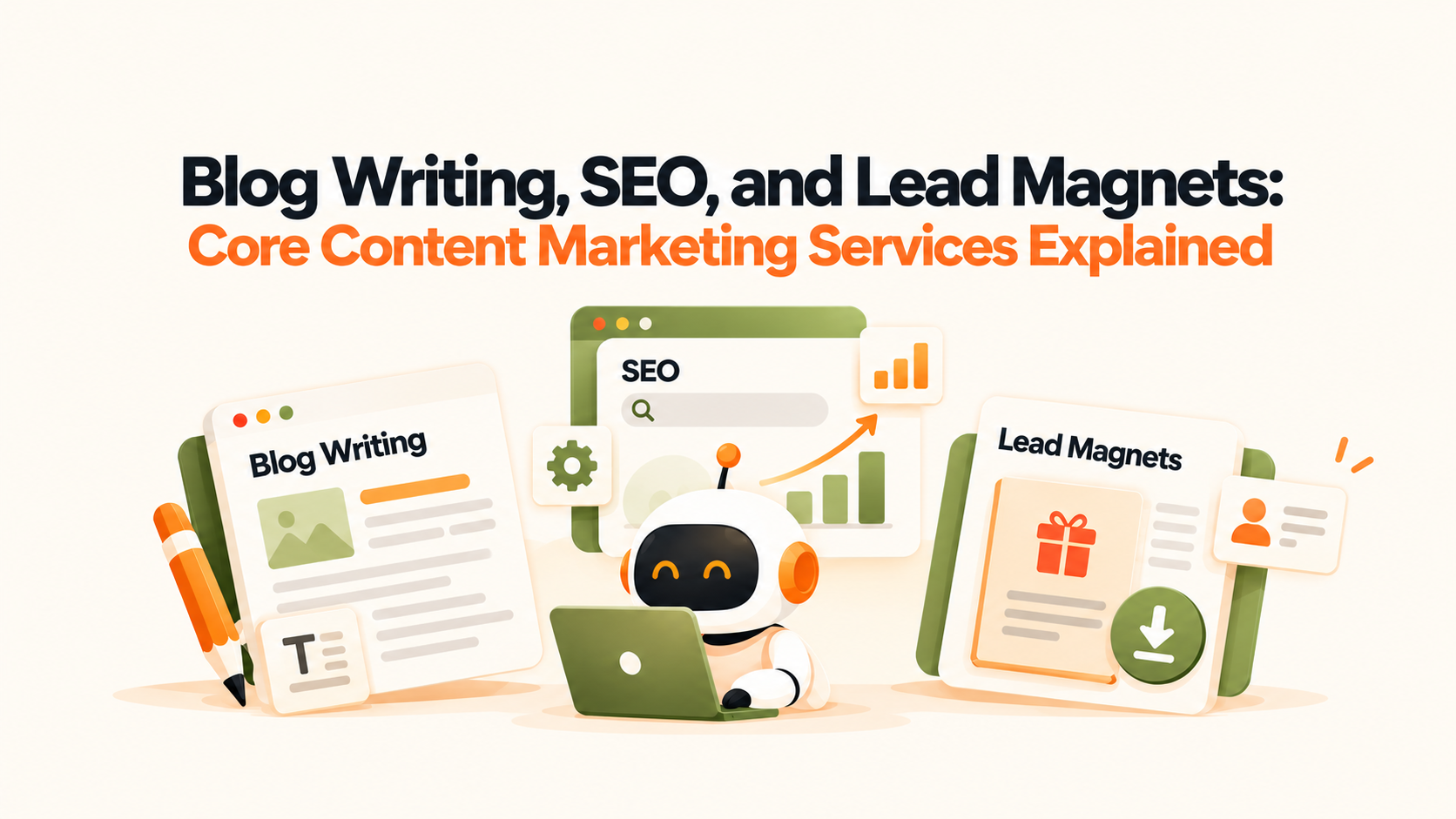
Blog Writing, SEO, and Lead Magnets: Core Content Marketing Services Explained
You don’t need more ‘marketing magic.’
You need three things that actually move the needle.
Blog writing. SEO. Lead magnets.
Together, they form the backbone of a content marketing system that attracts strangers, turns them into subscribers, and primes them to buy.
Below is a clear, no-fluff breakdown of each service, what’s included, and how they fit together so you can decide what to prioritize (or outsource) first.
1. Blog Writing: Your Engine for Traffic, Trust, and Leads
What blog writing services actually do
A solid blog writing service doesn’t just ‘write posts.’ It builds a repeatable content engine for your business. At ContentManics, that is our complete blog production service: brief, AI-assisted draft, senior human edit, and an SEO and AEO pass.
Typical deliverables include:
- Topic strategy and ideation – Researching what your audience searches for and what converts.
- SEO-optimized outlines – Structuring posts around search intent, not just keywords.
- Full-length articles – Clear, engaging posts that educate and persuade.
- On-page optimization – Titles, meta descriptions, headers, internal links, image alt text.
- Editing and proofreading – For tone, clarity, grammar, and brand voice.
- Publishing support (optional) – Formatting in your CMS, adding CTAs, scheduling.
Some managed services also handle:
- Building a custom writer pool for your niche.
- Integrating with your workflow tools (Notion, Google Docs, project boards).
- Managing deadlines, revisions, and quality control.
Why blog writing matters (beyond “having a blog”)
Regular, high-quality blogging does heavy lifting across your funnel:
- Attracts organic traffic by targeting real search queries your buyers use.
- Builds authority and trust by showing your expertise in public, searchable content.
- Creates reusable assets you can repurpose into social posts, emails, videos, and lead magnets.
- Supports sales by answering objections and educating prospects before they talk to you.
If you’re time-strapped, outsourcing blog writing frees you to focus on your business while keeping a consistent publishing schedule.
2. SEO: Making Sure Your Content Actually Gets Found
Great content that no one finds is just a diary. SEO ensures your best work shows up when it matters.
At a high level, SEO has three core pillars: technical, on-page, and off-page. Many teams now add AEO and GEO optimization on top so content is also cited in AI answers.
Technical SEO: The foundation
Technical SEO is about making your site easy for search engines (and users) to access and understand.
Key elements:
- Crawlability and indexation – XML sitemaps, robots.txt, fixing crawl errors.
- Site speed and Core Web Vitals – Fast-loading pages that don’t frustrate visitors.
- Mobile-friendliness – Responsive design for phones and tablets.
- Security – HTTPS/SSL for trust and ranking.
- Site architecture – Clear structure, logical categories, clean URLs.
- Structured data (Schema) – Helping Google display rich results (FAQs, reviews, etc.).
Without this foundation, even excellent content can struggle to rank.
On-page SEO: Optimizing what is on your pages
On-page SEO is everything you control directly on your site to signal relevance and satisfy search intent.
Core components:
- Keyword research & usage – Targeting the right terms and placing them naturally in titles, headings, and body copy.
- Content quality and depth – Comprehensive answers that match what users actually want.
- Meta tags – Compelling title tags and meta descriptions that improve click-through rates.
- Header structure – Clear H1, H2, H3 hierarchy for readability and SEO.
- Internal linking – Connecting related pages to spread authority and aid navigation.
- Image optimization – Compressed files, descriptive filenames, and alt text.
This is where blog writing and SEO overlap heavily: each post should be built around a primary keyword and intent, then optimized accordingly.
Off-page SEO: Building autho rity and trust
Off-page SEO covers actions outside your site that signal credibility to search engines.
Main levers:
- Backlinks – Links from relevant, authoritative sites pointing to yours.
- Brand mentions – Being talked about (with or without links) across the web.
- Digital PR and guest posts – Earning coverage and bylines on industry sites.
- Reviews and local citations – Especially important for local businesses (NAP consistency, Google Business Profile).
Think of off-page SEO as your reputation layer. The stronger it is, the more weight your on-page work carries.
3. Lead Magnets: Turning Readers Into Subscribers (and Buyers)
Traffic is great. But anonymous traffic doesn’t pay bills.
Lead magnets convert casual visitors into named leads you can nurture over time.
What a lead magnet is (and is not)
A lead magnet is a free, high-value resource offered in exchange for contact information—usually an email address.
It is not:
- A generic ‘Subscribe to our newsletter’ pitch.
- A random PDF no one asked for.
It is:
- A focused solution to a specific problem your audience already cares about.
- Something they can use immediately to get a quick win.
Common high-converting formats:
- Checklists and cheat sheets – Simple, actionable one-pagers.
- Templates and worksheets – Ready-to-use frameworks (email scripts, calendars, budgets).
- Short guides or ebooks – 5–15 pages of focused, practical advice.
- Mini-courses or video tutorials – A few short lessons delivered by email or on a landing page.
- Webinars or workshops – Live or recorded training sessions.
- Quizzes and assessments – Interactive tools that personalize results.
- Free trials, demos, or audits – Especially powerful for service-based businesses.
How lead magnets fit into your funnel
A typical lead magnet flow looks like this:
- Visitor lands on a blog post or landing page.
- Sees a relevant offer – e.g., ‘Download the SEO Checklist for Small Businesses.’
- Enters their email to unlock the resource.
- Gets instant access via a thank-you page and/or email.
- Enters a nurture sequence – additional tips, case studies, and soft pitches.
- Moves toward a sale – consultation, demo, or purchase.
The key is alignment: your lead magnet should match the topic of the content that brought them in.
Example: A post on ‘How to Do Keyword Research’ → lead magnet: ‘Keyword Research Checklist + Template.’ That congruence boosts both conversions and lead quality.
How Blog Writing, SEO, and Lead Magnets Work Together
These three services are not separate silos. They are layers of the same system.
- Blog writing creates the content that attracts and educates.
- SEO ensures that content ranks and gets found by the right people.
- Lead magnets capture those visitors as subscribers so you can keep talking to them.
A simple way to visualize it:
- Top of funnel (TOFU): SEO-optimized blog posts bring in organic traffic.
- Middle of funnel (MOFU): Lead magnets embedded in those posts convert readers into email subscribers.
- Bottom of funnel (BOFU): Email sequences and targeted content nurture leads toward a purchase.
You can start with just one piece. But the real compounding effect happens when all three are intentionally connected.
What to Prioritize First
It depends on where you are now.
If you have little or no content: Start with blog writing + basic on-page SEO. Publish a small set of strong, intent-matched posts before worrying about advanced link building.
If you already publish but get little traffic: Audit your on-page and technical SEO. Fix speed, mobile issues, metadata, internal linking, and keyword targeting.
If you get traffic but few leads: Add lead magnets tied to your best-performing posts. Create one focused asset per key topic and plug it into relevant articles.
How This Can Look as a Service Package
If you were to hire help, a core content marketing package might include:
Blog writing:
- 4–8 SEO-optimized posts per month
- Topic research, outlines, writing, editing
- On-page optimization (titles, meta, headers, internal links)
SEO:
- Technical audit and fixes (speed, mobile, indexation)
- Ongoing on-page optimization for new and existing content
- Basic off-page work (guest posts, digital PR, link outreach)
Lead magnets:
- 1–2 high-value assets per quarter (checklist, template, guide)
- Dedicated landing pages and CTAs in relevant posts
- Simple email nurture sequence to move subscribers toward a call or sale
You don’t need everything at once. But you do need a clear plan for how each piece supports your revenue goals.



Leave a Reply